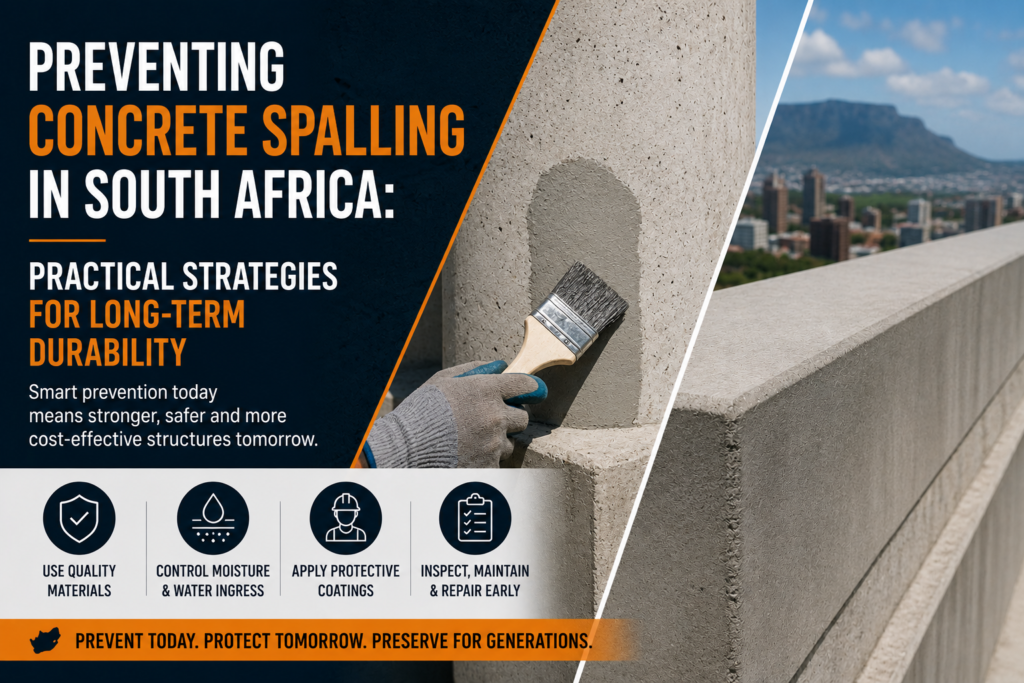
Preventing concrete spalling is significantly more cost-effective than repairing it. In South Africa—where environmental exposure ranges from high carbonation inland to aggressive chloride environments along the coast—a proactive approach is essential.
Design-Stage Considerations
Adequate Concrete Cover
Compliance with SANS 10100 and SANS 10164 ensures sufficient concrete cover to protect reinforcement from environmental exposure.
Durable Concrete Mix Design
A high-quality mix should:
- Minimise permeability
- Use supplementary cementitious materials (e.g., fly ash, slag)
- Maintain a low water-to-cement ratio
These measures slow down carbonation and chloride ingress.
Environmental Design Classification
Structures should be designed according to exposure conditions:
- Inland urban (carbonation risk)
- Coastal (chloride exposure)
- Industrial (chemical exposure)
Construction Best Practices
Proper Compaction and Placement
Eliminating voids is critical to preventing pathways for moisture and contaminants.
Effective Curing
Proper curing improves strength and durability, significantly reducing long-term deterioration.
Maintenance Strategies
Routine Inspections
Annual or biannual inspections help detect early signs of spalling and corrosion.
Protective Coatings and Sealers
Applying anti-carbonation coatings or water repellents reduces moisture ingress.
Crack Repair
Sealing cracks early prevents water penetration and protects embedded steel.
Waterproofing and Drainage
Balconies, roofs, and parking decks should have properly maintained waterproofing systems.
Cost vs Risk: The Preventative Advantage
Studies and industry data suggest that preventative maintenance can reduce lifecycle costs by up to 60–70% compared to reactive repairs—particularly for large commercial or municipal assets.
Conclusion
In the South African context, preventing concrete spalling requires a lifecycle approach—combining smart design, quality construction, and ongoing maintenance. The result is longer-lasting structures, reduced risk, and lower long-term costs.
References
- SANS 10164: Design for Durability
- SANS 2001-CC1: Concrete Works
- Cement & Concrete SA: Durability Guidelines
- fib Model Code for Concrete Structures (2010)
- The Concrete Institute (South Africa) Publications