Waterproofing Contractors in Durban and KZN
Specialist waterproofing and concrete repair for body corporates, facilities managers, property portfolios, main contractors and specifiers across Durban and KwaZulu-Natal.
Why Choose Spalling Worx KZN for Waterproofing
Structural Expertise, Not Just a Membrane Installer
Our core work is concrete spalling repair, crack injection and protective coatings on buildings that are already deteriorating. Waterproofing sits alongside that work, not apart from it. Where a waterproofing problem is connected to cracking, corrosion or structural movement, we can identify and address that connection under one contractor, rather than you coordinating a waterproofing company and a structural repair contractor separately and being left to arbitrate between them if something doesn't hold.
Solution-Led, Not System-Led
We don't start from a fixed product and work backwards. The right preparation, repair, detailing and waterproofing system depend on the specific substrate, its condition, its exposure, and what the structure needs to do — a coastal-facing balcony, an underground water tank and a commercial roof are three different problems, not one product applied three times.
Correctly Specified, Not Simply the Cheapest
The preparation, repair, detailing and waterproofing system specified for a project affect both what it costs upfront and how it performs afterwards. A quotation is worth judging against what it actually includes — the substrate preparation, any structural repair required, and the system specified for that exposure — rather than compared on price alone. We assess the actual problem first, and specify and price according to what the structure and conditions require.
Commercial-Grade Products, Specified Per Project
We work with established waterproofing product ranges — including Sika, Mapei, Promac and StonCor — and select from them according to substrate, exposure and intended use. No single manufacturer or system is our default; the project determines the specification.
Assessed First, Quoted in Writing
We assess the waterproofing problem on site before recommending anything. Where the project proceeds to quotation, we set out the recommended scope and waterproofing approach in writing. Because an initial assessment is generally non-destructive, some conditions — the true state of a substrate under an existing membrane, for example — can only be fully confirmed once work begins; where that affects scope, it's dealt with as part of the contract, not guessed at upfront.
12-Month Workmanship Guarantee
Our standard workmanship guarantee is 12 months, subject to the terms in your written quotation. Manufacturer warranties apply only where the specified system and manufacturer conditions allow. Both are confirmed in writing at quotation stage.
Our Waterproofing Services in Durban and KZN
Roof Waterproofing in Durban
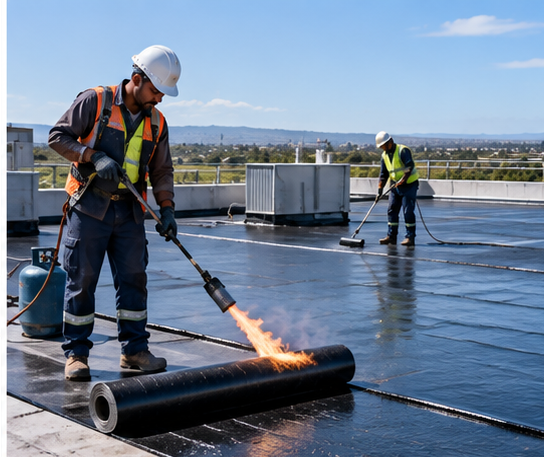
Roof waterproofing is a core service for buildings in Durban and KZN, and one of the areas where the wrong system for the roof type causes early failure. We waterproof concrete roofs, flat roofs and metal/IBR and corrugated roof sheeting, using torch-on modified bitumen membranes, liquid-applied membranes (acrylic, elastomeric or polyurethane), cementitious systems, or metal roof sealing and coating — selected according to the roof construction, falls, exposure and existing condition, not applied as a default. Parapets, upstands, flashings and penetrations are detailed as part of the same scope, since gaps in this detailing are a recognised cause of roof waterproofing failure.
Balconies, Decks & Walkways
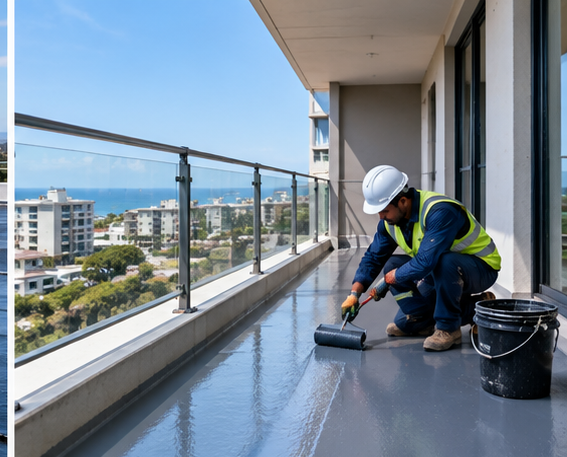
Balcony and deck waterproofing on coastal KZN buildings can be connected to structural repair — spalling affecting edge beams, soffits or slab edges on balconies facing the coast is one example — and waterproofing that area properly can mean addressing the structural condition as part of the same job. We apply trafficable liquid/resin waterproof membranes under tile, screed or as a finished walkable surface, and correct ponding or incorrect falls to drainage as part of the waterproofing scope, not as an afterthought.
Retaining Walls & Below-Grade Structures
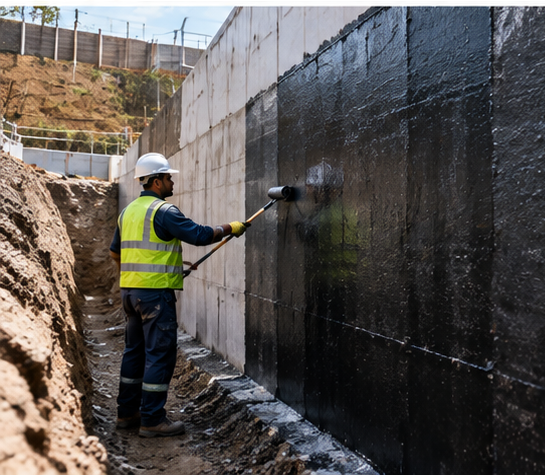
Basements, lift pits and parking structures and decks sit below or partly below ground, carry vehicle or hydrostatic loading, and are exposed to persistent moisture from the surrounding ground or structure — a different waterproofing problem to a roof or balcony. Where the external, water-facing side of the structure is accessible, we apply positive-side waterproofing — treating the surface the water actually meets before it can penetrate the structure. Where external access isn’t practical — an occupied basement, or a retaining wall backfilled long ago, for example — we apply negative-side/internal remedial waterproofing from the accessible internal face instead. Neither approach is universally correct; which one applies depends on access, the structure and the water pressure involved, and is confirmed on assessment rather than assumed. Where water ingress is coming through a structural crack rather than a failed surface membrane, we use crack injection to address the active ingress point directly, rather than waterproofing over a crack that will continue moving.
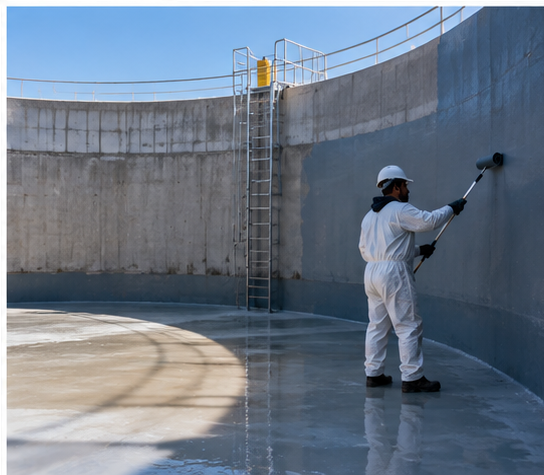
Tanks & Reservoirs (Water-Retaining Structures)
We waterproof both potable and non-potable water tanks and reservoirs. The system and product used are selected according to the specific structure and its intended use — a system suitable for a potable water tank is not automatically suitable for a stormwater attenuation tank, and vice versa, so this is confirmed against the project rather than assumed.
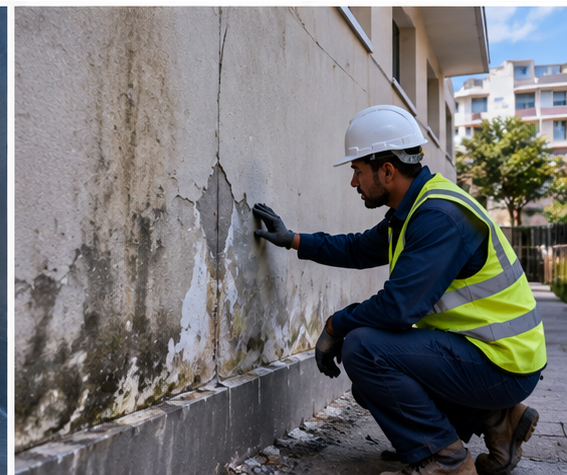
Damp-Proofing & Water-Ingress Assessment
Where a wall shows signs of persistent dampness or water ingress, we assess it based on practical experience, visual inspection, moisture-meter readings, the building’s general condition, and whatever construction detail is accessible without opening anything up. This initial assessment is not a specialist leak-detection or diagnostic service, and it cannot always identify a concealed water path with certainty before work starts — where that level of certainty is needed, opening up or removing sections of screed, coating or finish may be necessary, and that only happens once we are engaged under contract, not as part of a site visit. Where the cause is established, we apply external wall waterproof coatings and renders appropriate to the wall and exposure.
Who We Work With
We work with body corporates and sectional title schemes, managing agents and facilities managers, commercial and industrial property owners, developers, architects and engineers as specifiers, main contractors, and selected private building owners across Durban and KwaZulu-Natal. Whether you’re managing a single coastal apartment block or specifying waterproofing across a commercial portfolio, we scope the work to the property and the decision-maker involved, not a one-size scope regardless of client type.
The property types we work with:
- Body Corporates & Sectional Title
- Managing Agents & Facilities Managers
- Commercial & Industrial Property Owners
- Developers, Architects & Engineers (Specifiers)
- Main Contractors & Selected Private Building Owners
Our Waterproofing Process
Site Assessment
We inspect the affected area — visually, with a moisture meter where relevant, and against the building’s general condition and accessible construction detail. This step does not involve opening up finishes, coatings or membranes.
Written Quotation
Where the project proceeds, we set out our recommended scope and waterproofing approach or system in writing, priced against what we found during assessment.
Investigation Where Necessary (Once Under Contract)
On some projects, conditions can’t be fully confirmed without opening up existing screed, coatings, membranes or finishes. Where that’s required, it happens once we’re engaged under contract, and any scope adjustment arising from what’s found is agreed with you before proceeding.
Substrate Preparation & Repair
Cleaning, removal of failed material, crack injection or structural repair where required, and preparation of the substrate to receive the specified system.
Waterproofing System Application
The specified system — membrane, coating, or cementitious system — is applied according to manufacturer requirements for that product and substrate.
Inspection & Sign-Off
We walk the completed work against the agreed scope before handover, and confirm in writing the workmanship guarantee and any manufacturer warranty that applies to that specific project.
Why Waterproofing Fails Faster in Durban's Coastal Climate
Durban’s combination of salt-laden coastal air, high humidity, intense UV and heavy wind-driven rain places significant demands on waterproofing systems. In reinforced concrete structures exposed to this environment, sustained water ingress can allow chloride to reach reinforcing steel more readily — this is a contributing mechanism, alongside carbonation and other factors, in reinforcement corrosion and the cracking and spalling that can follow. This relationship doesn’t apply to every waterproofing failure or every substrate: a leaking metal roof sheet or a failed membrane on a non-structural surface doesn’t carry the same corrosion risk. Where the substrate is reinforced concrete in a coastal exposure, though, unresolved water ingress is a deterioration pathway worth taking seriously. UV also degrades exposed membranes over time, and wind-driven rain finds gaps in detailing — around parapets, upstands, door thresholds and penetrations — that a lower-spec installation may not have accounted for.
This is why properly specified waterproofing, applied to a correctly prepared substrate, matters beyond simply keeping water out. On reinforced concrete buildings already showing signs of deterioration, addressing water ingress is typically a relevant part of protecting the reinforcement from further exposure, alongside any structural repair the building needs. Correctly specified waterproofing, matched to the structure and its exposure, also supports longer intervals between maintenance cycles on a property that in most cases needs to stay occupied or operational throughout.
Signs of Waterproofing Failure to Watch For
- Damp patches, staining or discolouration on walls or ceilings
- Ponding water on a roof, balcony or deck after rain
- Peeling, bubbling or cracking of an existing waterproof coating or paint finish
- A musty or damp smell in an enclosed space
- Visible cracking at parapets, upstands, joints or penetrations
- Water leaking through a slab, wall or balcony soffit
- A water tank or reservoir losing level without an obvious cause
The point where water becomes visible is not necessarily the point where it enters the building — which is one of the reasons a site assessment matters before any repair is scoped.
Waterproofing Contractors for Ballito and the North Coast
Spalling Worx KZN carries out waterproofing assessments and repairs along the North Coast, from Umhlanga and Mount Edgecombe to Ballito and Salt Rock, and further north for larger projects. Buildings here face constant salt-laden air and wind-driven rain, so roofs, balconies and podium decks need systems matched to that exposure. Request a site assessment and we will inspect the problem, identify the cause of the leak and recommend the right system. See our guide to balcony waterproofing in Durban and KZN for how system choice affects results.
How We Approach a Waterproofing Project
- Cause first. We establish why the waterproofing is failing — movement, drainage, product mismatch or age — before recommending a repair.
- Preparation, detailing and a matched system. The system is selected for the substrate and its exposure, not applied as a default.
- A written scope after assessment. Where investigation under contract changes the scope, it is agreed with you first.
- A 12-month workmanship guarantee, subject to the terms in your written quotation.
- Safe working. Each project is planned around its site conditions, with appropriate risk assessments, safe working procedures and competent personnel, including for work at height.
Spalling Worx KZN specialises in concrete repair and rehabilitation. Where structural assessment, design or certification is required, this is undertaken by an appropriately qualified engineer, either appointed by the client or separately agreed as part of the project scope.
Related Guides
Areas We Serve Across Durban and KwaZulu-Natal
Durban CBD, Berea, Morningside, Glenwood, Musgrave, Durban North, Springfield Park, Prospecton, Mobeni and Jacobs.
Umhlanga, Umhlanga Ridge, La Lucia, Mount Edgecombe, Cornubia, Umdloti, Ballito and Salt Rock.
Westville, Pinetown, Kloof, Hillcrest, Gillitts and New Germany.
Amanzimtoti, Kingsburgh, Illovo and Scottburgh.
Pietermaritzburg, Richards Bay and Empangeni for larger commercial and industrial projects.
If your site falls outside these areas, contact us anyway — we take on larger commercial and industrial waterproofing contracts throughout KwaZulu-Natal.
Waterproofing FAQs
How do I choose between waterproofing companies in Durban?
Ask whether they assess the site before quoting, whether preparation and any necessary structural repair are included in the scope, and whether the system specified is matched to the substrate and exposure rather than applied as a default. A written quotation you can judge against what it actually includes matters more than the number on its own.
Do you provide a written quotation for waterproofing work?
Yes. We assess the problem on site first. Where the project proceeds, we provide a written quotation setting out the recommended scope and waterproofing approach or system. An initial assessment is generally non-destructive, so some conditions can only be confirmed once work begins — where that changes scope, it’s agreed with you as part of the contract.
How much does waterproofing cost in Durban?
There’s no single rate, because the right system and the amount of preparation or repair needed depend on the substrate, its condition and what it’s exposed to. A quote given without a site assessment hasn’t accounted for any of that.
Do you handle both new waterproofing and fixing existing failed waterproofing?
Both, but most of our waterproofing work is remedial — fixing waterproofing that has already failed, often connected to structural deterioration. New installation is also carried out.
Can you waterproof a water tank used for drinking water?
We undertake both potable and non-potable tanks and reservoirs. The system and product are selected for the specific structure and its intended use, since not every waterproofing system is suitable for potable water.
Do you offer leak detection?
Not as a specialist diagnostic service. Our assessment is based on experience, visual inspection, moisture-meter readings and accessible construction detail. Where a concealed water path needs to be confirmed with certainty, that typically requires opening up a section of finish, coating or membrane — which happens once we’re engaged under contract, not during an initial site visit.
Is there a warranty on your waterproofing work?
Our standard workmanship guarantee is 12 months, subject to the terms in your written quotation. Manufacturer warranties apply only where the specified system and manufacturer conditions allow. Both are confirmed in writing at quotation stage for the specific system recommended.
Do you also handle structural or spalling repair alongside waterproofing?
Yes — structural concrete repair, crack injection and protective coatings are our core work, and waterproofing is frequently part of the same project. Where a waterproofing problem is connected to a structural issue, we can address both under one contract.
Do you waterproof metal or IBR roofs, or only concrete roofs?
Both. Roof waterproofing systems are selected according to the roof construction — concrete, flat or metal/IBR and corrugated sheeting each need a different approach.
Do you work with body corporates and managing agents?
Yes — body corporates, managing agents, facilities managers, commercial and industrial property owners, specifiers, main contractors and private building owners are among our regular clients across Durban and KZN.