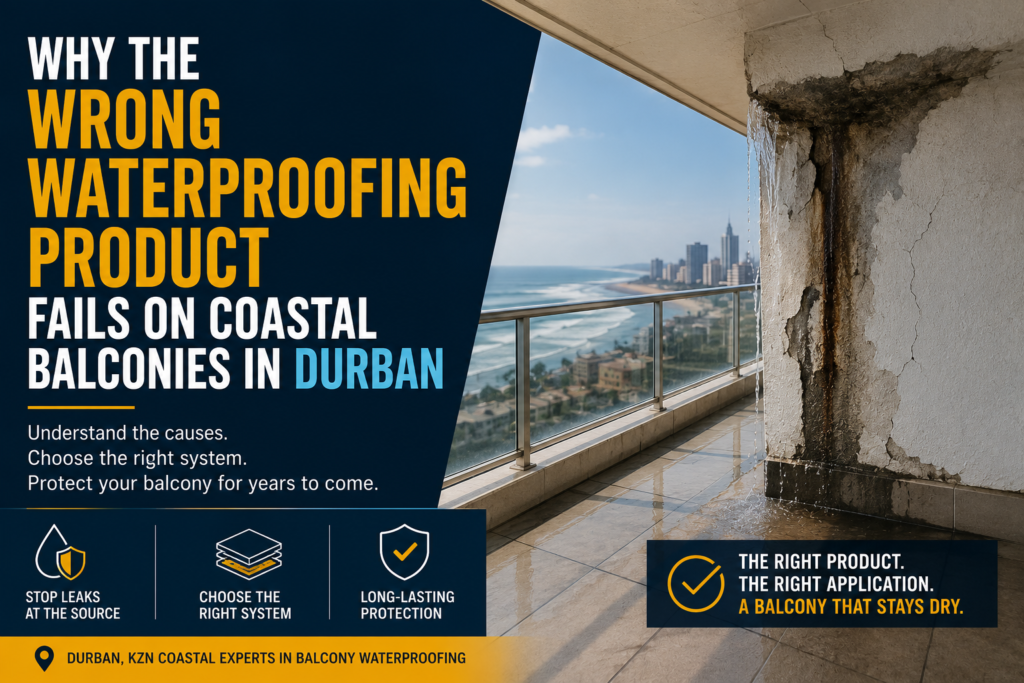
A body corporate in Durban re-waterproofs the same balcony for the third time in a decade, and it leaks again within two years. Nobody involved did a bad job applying the product. The product itself was never going to work on that balcony, because nobody asked why the last one failed before choosing what to put down next.
That’s the pattern behind most repeat waterproofing failures: not poor workmanship, but the wrong system for the conditions the balcony is actually exposed to. This article covers why that mismatch happens, what actually causes balcony waterproofing to fail on KZN’s coast specifically, and how to choose a system that’s matched to the problem rather than just reapplying whatever was there before.
Balconies move, and that’s where most waterproofing failures start
Every balcony experiences some degree of movement: thermal expansion and contraction as temperatures shift through the day, and structural movement as the building settles, particularly in the years after construction. A waterproofing system has to accommodate that movement, or it doesn’t matter how well it was applied; a crack that opens in the substrate becomes a crack in the waterproofing sitting on top of it.
This is where a lot of balcony waterproofing failures actually start: a rigid, cementitious waterproofing system, well suited to a basement or a planter box, where movement is minimal, applied to a balcony that’s exposed to real thermal cycling and structural movement. The system was never wrong in general; it was wrong for that application. Using the right product for the right application is critical to a successful outcome. Matching the system to what the surface is actually exposed to, not just applying whatever’s on the van, is what separates a repair that lasts from one that fails again in a few years.
The other major failure driver: ponding water and poor drainage
Even the correct, flexible system will fail early if water isn’t draining off the balcony properly. Balconies need a proper fall (slope) toward drainage outlets, and those outlets need to stay clear. Standing water sitting on a membrane for extended periods accelerates its breakdown far faster than normal weather exposure, and a blocked or slow drain turns an otherwise well-specified waterproofing job into a recurring problem regardless of which product was used.
Checking that drainage outlets are clear of debris is one of the simplest, cheapest things a body corporate or facility manager can do between formal inspections, and it’s routinely overlooked.
Choosing the right balcony waterproofing system
Spalling Worx KZN installs torch-on, liquid-applied, and cementitious waterproofing systems, and each suits different conditions:
- Liquid-applied membranes form a seamless, flexible, UV-resistant coating that conforms to complex shapes, upstands, and penetrations, generally the strongest fit for balconies specifically, where movement accommodation and detailing around door thresholds, railings, and drainage outlets matter more than on a large flat roof.
- Torch-on (bituminous sheet) membranes are heat-bonded and durable, well suited to larger, simpler flat areas, and typically get a protective screed laid over them before tiling. Long-lasting when correctly detailed, but less forgiving around complex balcony geometry than a liquid system.
- Cementitious waterproofing is rigid and well suited to areas with minimal movement, basements, planter boxes, below-grade applications, but is a poor fit for a balcony experiencing real thermal and structural movement, for the reasons covered above.
None of these is a universally “better” product. The right one depends on the specific balcony’s shape, exposure, and movement, which is exactly why diagnosis has to come before product selection, not after, using Sika’s South African waterproofing systems range as one example of how broad that product range actually is.
Why this fails faster on KZN’s coast specifically
Durban’s combination of intense UV exposure, high humidity, and salt-laden coastal air is a harder environment for any waterproofing membrane than an inland, drier climate. UV degrades exposed membranes faster, and once a membrane does fail, chloride-laden moisture reaching the concrete underneath doesn’t just cause a leak, it accelerates reinforcement corrosion in the slab itself. A balcony waterproofing failure on the coast is rarely just a waterproofing problem for long; it becomes a concrete repair problem too if it isn’t caught and corrected early.
What a proper waterproofing repair actually involves
A waterproofing repair that’s going to last starts with diagnosing why the previous system failed, movement, ponding, product mismatch, membrane age, or a combination, rather than simply reapplying the same type of system that just failed. From there:
- Diagnosis. Establish the actual cause of failure before specifying a replacement system.
- Surface preparation and correction. This includes correcting falls/drainage slope if ponding was a contributing factor, not just cleaning the surface.
- System selection matched to the application. Based on the balcony’s movement, exposure, and geometry, not a default product.
- Detailing at vulnerable points. Upstands, penetrations, drainage outlets, and door thresholds are where failures concentrate; these need proper attention, not just the flat field of the balcony.
- Protective/wearing layer, where the system requires one (e.g. a screed over torch-on membrane before tiling), to protect the membrane from the trades that follow.
Waterproofing failures and corrosion on KZN’s coast
Waterproofing failures and reinforcement corrosion often occur together on KZN’s coast. Leaking balconies, planter boxes, roofs, and podium decks let moisture penetrate reinforced concrete, increasing corrosion risk wherever waterproofing has deteriorated or failed. It’s a common defect combination across the region’s coastal building stock, and one of the easiest to under-diagnose: a leak gets treated as a waterproofing problem alone, when the concrete underneath also needs attention.
Identifying the underlying cause of a leak, movement, drainage, product mismatch, or age, matters as much as identifying the leak itself. Reapplying the same type of system that just failed, without addressing why it failed, is the most common reason balcony waterproofing keeps needing to be redone every few years. The same is true whether you’re in Durban itself or further along the KZN coast.
Frequently asked questions
Why does my balcony keep leaking after being waterproofed?
Usually because the underlying cause was never addressed. A rigid system applied to a balcony with real movement, or a system reapplied without fixing poor drainage, will fail again even if the workmanship was fine.
What’s the difference between torch-on and liquid waterproofing for a balcony?
Liquid-applied membranes are flexible and conform well to complex balcony shapes and detailing around penetrations. Torch-on sheet membranes suit larger, simpler flat areas and are typically overlaid with a protective screed before tiling.
Can balcony waterproofing be repaired without removing the tiles?
It depends on where the failure is and what system is being installed. Some liquid systems can be installed over existing surfaces in certain conditions, but this needs to be assessed on site, not assumed.
How would you carry out the scope of works?
It starts with diagnosing why the existing waterproofing failed, movement, drainage, product mismatch, or age, before specifying a replacement system, then detailing the vulnerable points (upstands, penetrations, drainage outlets) alongside the main surface.
How long will the repairs last?
That depends on whether the system is properly matched to the balcony’s movement and exposure, and whether drainage is corrected where it’s a contributing factor. A mismatched system will fail again regardless of how well it’s installed.
Do you guarantee your work?
Guarantees are tied to the materials and systems used in the repair, in addition to the labour, typically backed by both the material supplier and the contractor.
Get a proper diagnosis before the next re-waterproofing job
If your body corporate or facility is on its second or third round of balcony waterproofing and it keeps failing, Spalling Worx KZN offers site inspections and assessments across KwaZulu-Natal, from Durban through to Richards Bay, Port Shepstone, and Pietermaritzburg. Call 082 091 7731 or book a free Asset Protection Review. For roofs, basements and other waterproofing work, see our waterproofing contractors in Durban and KZN page, or the full guide to concrete waterproofing for KZN buildings.