A body corporate in KZN asks for “the roof waterproofed” and gets a quote that also covers the parking basement retaining wall with the same flexible membrane system used up top, and within a year, damp is back in the basement. The roof system wasn’t wrong. It was wrong for a wall holding back groundwater under pressure, which is a completely different problem to a roof shedding rainwater.
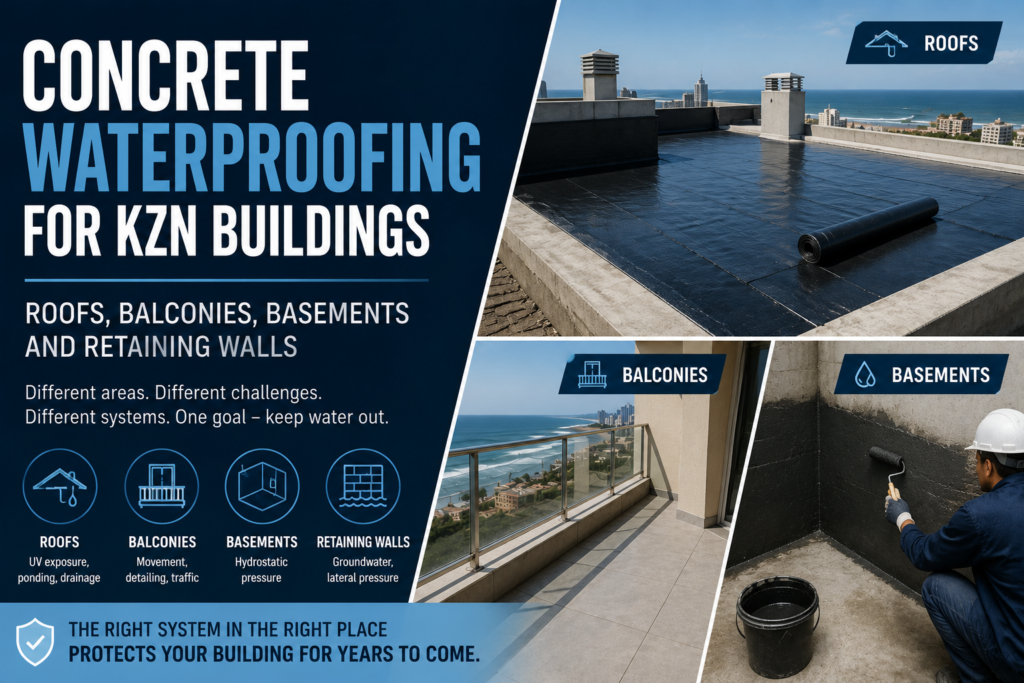
“Concrete waterproofing” isn’t one job. It’s several different problems that happen to share a name. A roof deals with ponding water and UV exposure. A balcony deals with movement and complex detailing around penetrations. A basement or retaining wall deals with sustained hydrostatic pressure pushing water toward the structure, not just water sitting on top of it. Treating all three the same way is one of the more common, and more expensive, mistakes in waterproofing specification. This guide covers what each part of a building actually needs, and links to more detailed guides where we have them.
Roof waterproofing for flat concrete slabs
Flat concrete roofs need a proper fall (slope) toward drainage, a minimum of 1:80 under South African building regulations, with a steeper 1:50 sometimes needed on concrete slabs specifically to account for construction tolerances, since a “flat” slab is never perfectly flat in practice. Without adequate fall, water pools instead of draining, and ponding accelerates the breakdown of any waterproofing system regardless of how good it is.
For the membrane itself, two approaches are most common:
- Torch-on bituminous membranes are heat-bonded, durable, and well established in South Africa, but are vulnerable to UV degradation over time without a reflective or protective top layer.
- Liquid-applied membranes (acrylic, polyurethane, or silicone-based) form a seamless coating; silicone-based systems in particular hold up well against UV in a high-sun climate.
Under South African building regulations (SANS 10400-L), roof waterproofing must be installed by a competent person following the manufacturer’s instructions, and must remain watertight for a minimum of five years with nothing more than normal gutter and downpipe maintenance, with more complex or hard-to-replace roof systems expected to perform for considerably longer.
Balcony waterproofing
Balconies face a different problem to roofs: real thermal and structural movement, plus more complex detailing around door thresholds, railings, and drainage outlets. A rigid system that works fine on a basement wall or a simple flat roof can crack and fail on a balcony because it can’t accommodate that movement, which is exactly why balconies generally call for a flexible, liquid-applied system rather than a rigid one.
Spalling Worx KZN installs torch-on, liquid-applied, and cementitious systems, and matching the right one to a balcony’s specific movement and exposure is worth a proper site assessment rather than a default product.
Basement and retaining wall waterproofing
Basements and retaining walls face sustained hydrostatic pressure, groundwater actively pushing against the structure, not just water sitting on a surface, which is a fundamentally different load on a waterproofing system than a roof or balcony ever sees.
There are two broad approaches, worth understanding regardless of which contractor you use:
- Positive-side (external) waterproofing places the barrier on the outside of the wall, between the soil/water and the structure itself. This is generally considered the more robust approach: water never reaches the structural concrete or the reinforcing steel at all, which protects both the waterproofing and the structure’s long-term durability. It’s the preferred approach for new builds, where the excavation is already open and external access is straightforward.
- Negative-side (internal) waterproofing is applied from the inside, which matters most for retrofits where excavating the exterior isn’t practical, for example, a below-ground level in an existing occupied building. It’s more accessible to install and inspect, but it has a real limitation: negative-side coatings don’t stop water from entering the concrete itself, they only prevent it from reaching the interior space, and paint-on coatings alone can’t reliably withstand sustained hydrostatic pressure. Under enough pressure, they can delaminate and the damp returns.
Using the right product for the right application is critical to a successful outcome. For existing buildings where full excavation isn’t practical, negative-side systems combined with proper drainage are usually the realistic option; for new builds or where excavation is feasible, positive-side is the stronger long-term choice. Which one is right depends on what’s actually achievable on that specific building, not a default preference, and it’s a fair question to ask any contractor quoting basement or retaining wall work which approach they’re proposing, and why.
Why treating “waterproofing” as one uniform job causes failures
The common thread across all three areas: the right system depends on what the surface is actually exposed to, ponding and UV on a roof, movement and detailing on a balcony, sustained water pressure on a basement wall, and a system that’s correct for one of these is often the wrong choice for another. A flexible balcony-style membrane isn’t designed to resist hydrostatic pressure; a rigid, basement-style cementitious coating isn’t designed to move with a balcony. Specifying “waterproofing” as a single line item without distinguishing which part of the building it’s actually protecting, and what that part is exposed to, is how mismatched systems end up installed in the first place.
Where waterproofing does fail, the reinforcement corrosion underneath rarely stays unaffected for long. Ongoing moisture ingress is one of the more common drivers of reinforcement corrosion across KZN’s coastal building stock, so a waterproofing failure and a concrete repair need are often the same underlying problem showing up in two different ways.
Why one system rarely suits a whole building
Waterproofing decisions on KZN buildings are often made without distinguishing between these different applications. The same system gets specified across a roof, a balcony, and a basement because it’s simpler to quote one product for the whole job, not because it’s the right technical choice for all three. Identifying which part of the building is actually being protected, and what it’s exposed to, is the first step to a waterproofing job that actually lasts. The same is true whether you’re in Durban itself or further along the KZN coast.
Frequently asked questions
What’s the difference between positive-side and negative-side waterproofing?
Positive-side waterproofing is applied on the exterior, between the water source and the structure, and is generally the stronger long-term approach since water never reaches the concrete. Negative-side is applied from the interior, which is more practical for retrofits on existing buildings, but has real limitations against sustained water pressure.
How often does roof waterproofing need to be redone?
South African building regulations require roof waterproofing to remain watertight for a minimum of five years with only normal maintenance, and well-specified systems on complex roofs are expected to last considerably longer. UV exposure, ponding from poor drainage, and membrane type all affect the real-world lifespan.
Can basement waterproofing be added after a building is already occupied?
Yes, though the approach usually shifts toward negative-side (internal) waterproofing combined with proper drainage, since excavating around an existing, occupied basement wall for external access is rarely practical.
How would you carry out the scope of works?
It starts with identifying exactly which part of the building is being waterproofed and what it’s exposed to, ponding and UV, movement and detailing, or hydrostatic pressure, before specifying a system, rather than quoting one product across the whole job.
Do you guarantee your work?
Guarantees are tied to the materials and systems used in the repair, in addition to the labour, typically backed by both the material supplier and the contractor, and explained clearly before work starts rather than after.
Get the right system for the right part of your building
If your building needs waterproofing attention, whether it’s a roof, a balcony, a basement, or a retaining wall, Spalling Worx KZN offers site inspections and assessments across KwaZulu-Natal, from Durban through to Richards Bay, Port Shepstone, and Pietermaritzburg. Call 082 091 7731 or book a free Asset Protection Review. See also our waterproofing services in Durban and KZN, or why the wrong product fails on coastal balconies.