A trustee at a KZN body corporate gets a quote for concrete repairs to a parking garage soffit, and it’s the first one they’ve ever had to make sense of. It’s got line items like “polymer-modified mortar,” “anti-carbonation coating,” and “reinforcement passivation,” a price that’s several times the cost of repainting the lobby, and no obvious way to tell whether it’s fair, thorough, or a waste of the body corporate’s funds.
That’s a different problem to most maintenance decisions a body corporate makes. Repainting a wall or fixing a leaking tap doesn’t need much technical judgement to evaluate. A concrete repair quote does, and getting it wrong either wastes money on unnecessary work or, worse, approves a repair that doesn’t actually fix the cause and has to be redone in a few years, at further cost to the scheme.
This article sets out what trustees and managing agents should understand before signing off on concrete repairs: why they cost and look different from routine maintenance, how the process should work, what a proper quote actually contains, and the questions worth asking before approving anything.
Why concrete repair costs more and takes more judgement than routine maintenance
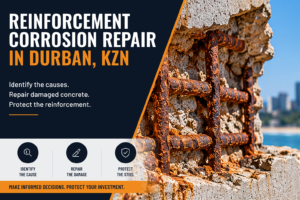
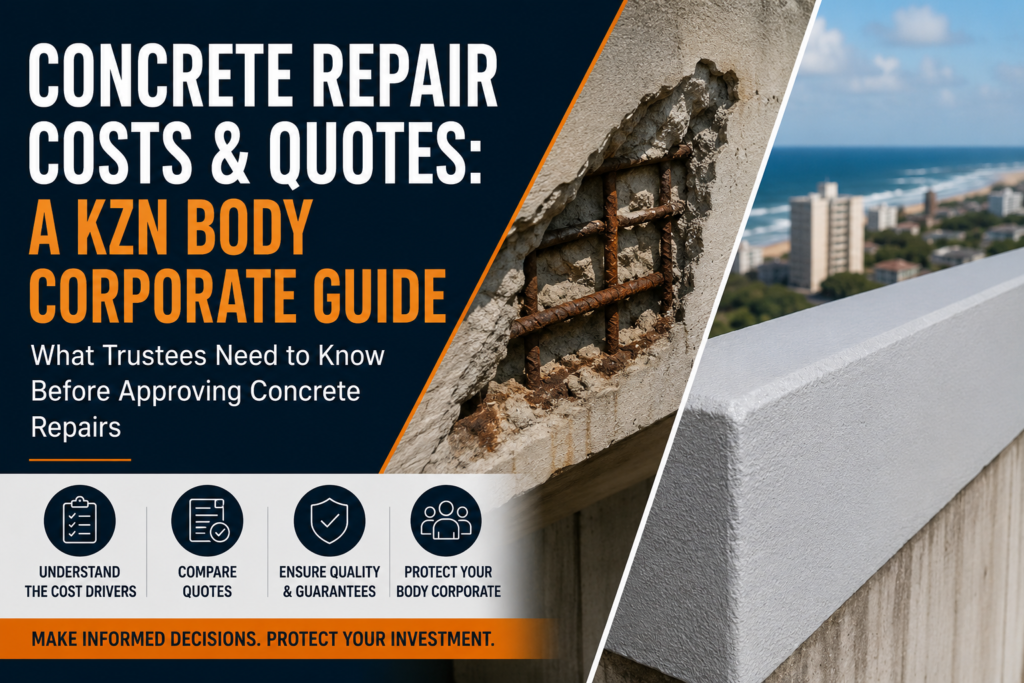
Concrete spalling, sometimes called “concrete cancer,” isn’t cosmetic damage. It starts when moisture and chloride from salt-laden coastal air reach the steel reinforcing inside the concrete. The steel begins to rust, rust expands, and the expansion cracks and pushes off the concrete around it. What a trustee sees on the surface (a crack, a bulge, flaking paint, a rust stain) is usually the late-stage symptom of a process that’s been happening inside the concrete for a while.
That matters for approval decisions for one reason: painting over the visible damage without treating the reinforcement doesn’t solve the problem. It hides it, temporarily, while the corrosion continues underneath. A body corporate that approves the cheaper cosmetic fix is very likely to be back here in a few years needing a bigger repair.
Fix it early and it’s a maintenance line item. Leave it, and it can turn into the kind of unplanned, significant expense that pushes a scheme toward a special levy. (What actually funds a given repair, reserve fund or special levy, depends on the scheme’s own financial position and trustee decisions, which is a governance question for your managing agent, not something we’ll prescribe here.)
This is also why proper concrete spalling repair services cost and look different from a repaint. A proper repair has to remove the affected concrete, treat the exposed steel, rebuild the concrete section, and protect it, not just cover it.
How the process should work
- Site inspection and assessment. A reputable contractor should inspect the affected areas in person before quoting, not price off photos alone. This is where the actual cause and extent of the damage gets identified, not just the visible symptom. For larger or more serious cases, it’s reasonable to ask whether an independent structural engineer, for example one registered with the South African Institution of Civil Engineering (SAICE), has been involved in the assessment.
- Scope of works and itemised quote. Trustees should receive a written scope that explains what’s being done and why, broken down by item, not a single lump-sum figure. This is a completely reasonable thing to ask for if it isn’t offered.
- Approval and funding. Addressing concrete deterioration early keeps maintenance predictable and budgeted for; leaving it tends to turn into the kind of unplanned expense that forces a special levy. Whether a specific repair is funded from the reserve fund or a special levy depends on the scheme’s own financial position and trustee decisions; that’s a governance question for your managing agent, and the Community Schemes Ombud Service is the formal channel if a funding or maintenance dispute needs to be resolved. Either way, trustees are entitled to a clear written scope and quote before committing funds.
- Execution. For occupied buildings (and most body corporate buildings are occupied), the contractor should manage access, safety, and disruption to residents as part of the job, not as an afterthought.
- Sign-off and guarantee. A completed repair should come with a guarantee tied to the materials used, not just the labour, typically backed by both the material supplier and the contractor.
What should actually be in a concrete repair quote
A properly prepared concrete repair quote looks quite different from a painting or general maintenance quote. Trustees are entitled to see:
- A diagnosis, not just a price. What caused the deterioration (corrosion, carbonation, waterproofing failure) should be stated, not assumed.
- An itemised pricing schedule: quantities in square metres or linear metres, a rate, and an amount per line item, not a single lump sum. Sub-total, VAT, and total should be shown separately.
- Named products or systems, where the contractor is certain of them. If a quote can’t say what it’s using, that’s worth asking about. For larger jobs, it’s reasonable to expect the contractor’s supplier to conduct their own technical site survey to confirm the specification before work starts; this is standard practice, not an extra.
- Supporting documentation, either included or listed as available on request: a written specification, the supplier’s guarantee, the contractor’s own guarantee (ideally “back-to-back” with the supplier’s, meaning the contractor stands behind the same terms the manufacturer offers), a safety plan (particularly for work at height), and a handover or final release certificate once the job is done.
- Proof the contractor can actually deliver: current tax compliance, public liability insurance, and references are all reasonable to ask for on a job of any size.
- A realistic timeline, including how disruption to residents or building operations will be managed.
Using the right product for the right application is critical to a successful outcome. Matching the repair system to the actual cause of deterioration, not just applying a standard fix, is what separates a repair that lasts from one that fails again in a few years. That’s as true for the contractor doing the work as it is for the trustees evaluating the quote: a quote that can’t explain why it’s using a particular system is harder to trust than one that can.
A note on comparing quotes
It’s reasonable for trustees to get more than one quote. Most guidance on body corporate procurement recommends it, and for a significant expense it’s good governance. But concrete repair is not a commodity service where the lowest number wins by default. Two quotes for “fixing” the same visible crack can represent completely different scopes of work: one might address the underlying corrosion, and the other might just patch the surface. Comparing quotes on price alone, without comparing scope, is comparing two different jobs.
We will never compromise on quality. In a market where a lot of contractors compete on price, differentiating through the standard of the work and the durability of the outcome matters more to us than being the cheapest number on the page. Trustees evaluating quotes are entitled to ask the same standard of every contractor they consider: what exactly is included, and why.
Early warning signs on KZN buildings
Buildings along KZN’s coast are exposed to early concrete deterioration. Chloride exposure from salt-laden coastal air is a significant driver of it across the region’s building stock, and it’s not a problem that resolves on its own. Concrete spalling repair is a specialised niche: it takes proper diagnosis, not just a grinder and a bag of cement.
If you’re a trustee or managing agent, it’s worth knowing the early warning signs before they become a bigger, more expensive job:
- Cracks appearing in concrete, especially along edges, corners, or beams
- Flaking or bubbling paint on walls, soffits, or beams
- Rust stains bleeding through the paint or concrete surface
- Areas of concrete that sound hollow when tapped, a sign the concrete has started to separate from the steel beneath it
If you’re seeing any of these on your building, it’s worth having it looked at properly before it spreads further. The same is true whether you’re in Durban itself or further along the KZN coast.
Frequently asked questions
How much will concrete repairs cost?
There’s no honest single figure, but the main drivers are consistent from job to job: how much steel corrosion has actually taken hold (a repair to a few small spalled areas is a different job to widespread reinforcement corrosion across a façade), how the work is accessed (scaffolding or rope access on a high-rise adds real cost before a single repair is even done), and how exposed the building is to coastal salt air, which affects both the extent of damage and the protective coating system needed. A proper site inspection comes before a firm price; be cautious of any quote given without someone having actually assessed the building.
Can you itemise your quote?
Yes, and trustees should expect this as standard from any contractor. A proper scope of works breaks the job down by area, quantity, and repair method, not just a single total, with sub-total, VAT, and the final total shown separately, so trustees can see exactly what they’re paying for.
Do you guarantee your work?
Guarantees should be tied to the materials and systems used in the repair, in addition to the labour, ideally backed by both the material supplier and the contractor, and should be explained clearly before work starts, not after.
Does the concrete need to be repaired, or can it just be painted over?
If there’s active reinforcement corrosion underneath, painting over it treats the symptom, not the cause, and the damage will continue under the new coating. A proper assessment will tell you which situation you’re dealing with, and why.
How long will the repairs last?
This depends on correctly matching the repair method and materials to the actual cause of deterioration. A repair that properly addresses the underlying corrosion or waterproofing failure lasts far longer than one that only treats the visible symptom, which is why diagnosis matters as much as execution.
When can work start, and how disruptive will it be to residents?
This should be discussed and agreed before approval, not worked out on site once the job has started. Ask any contractor you’re considering how they plan to manage access, safety, and disruption to residents in an occupied building.
Getting a second opinion, or a first one
If your body corporate has received a concrete repair quote and isn’t sure what to make of it, or hasn’t had the building assessed at all yet, Spalling Worx KZN offers site inspections and quotes across KwaZulu-Natal, from Durban through to Richards Bay, Port Shepstone, and Pietermaritzburg. Call 082 091 7731 or book a free Asset Protection Review to arrange an assessment.