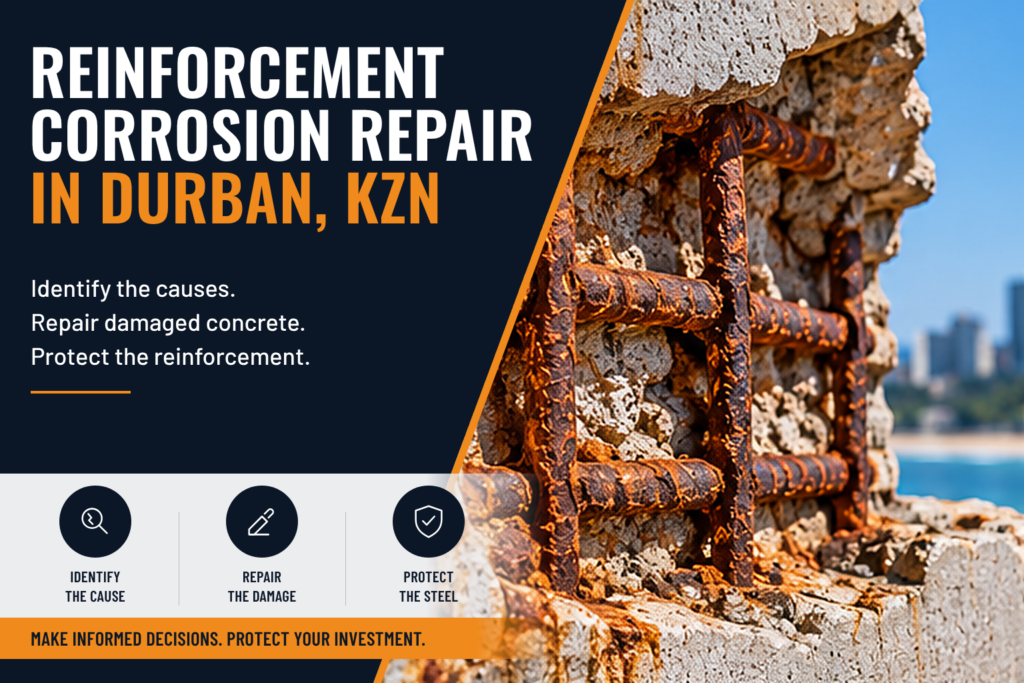
An engineer taps a hammer along a beam soffit in a Durban high-rise during a routine inspection and gets a dull, hollow sound where the concrete should ring solid. There’s no visible crack yet, no rust staining, nothing a building manager walking past would notice. But underneath, the steel reinforcement has already started corroding, expanding, and pushing the concrete away from the bar — and by the time it’s visible as a crack or a spalled patch, the corrosion has usually been active for a while.
That gap — between when reinforcement corrosion starts and when it becomes visible — is where the real diagnostic and repair decisions get made. This article covers reinforcement corrosion repair in Durban and along the KZN coast (the process behind what’s often called rebar corrosion or “concrete cancer”, and the root cause of concrete spalling): why coastal buildings are particularly exposed, how it’s diagnosed before it becomes obvious spalling, what a repair involves, and what drives the cost.
Why KZN’s coastal buildings are especially exposed to reinforcement corrosion
Reinforced concrete relies on a quiet piece of chemistry to protect the steel inside it: the high alkalinity of fresh concrete (a pH of around 12.5) forms a thin, stable oxide layer on the surface of the steel — the passivation layer — that protects it from corrosion for as long as that alkalinity holds. Two things break it down, and KZN’s coast delivers both.
Chloride ingress. Salt-laden coastal air carries chloride ions that penetrate concrete through diffusion, capillary action, and permeation. Once chloride concentration at the reinforcement reaches a critical threshold, it breaks down the passivation layer locally and corrosion begins — even while the surrounding concrete looks completely sound.
Carbonation. Atmospheric CO₂ reacts with calcium hydroxide in the concrete, gradually lowering its pH until the passive layer can no longer be maintained (the UCT monograph cited below puts that point at a pH below roughly 10.5). Carbonation also lowers the chloride threshold needed to trigger corrosion, so the two mechanisms compound each other rather than acting independently. (See the Institute of Corrosion‘s overview of chloride- and carbonation-induced corrosion for more technical detail.)
Durban’s humidity, salt spray, and wet/dry cycling accelerate both processes compared to inland environments, which is why coastal buildings tend to show reinforcement corrosion earlier and more extensively than the same design and age of building further inland.
How we diagnose reinforcement corrosion before it becomes visible spalling
By the time corrosion is visible as cracking, rust staining, or spalled concrete, it’s already in the propagation phase — active and progressing. Picking it up earlier changes what a repair looks like and what it costs. Early diagnosis starts with what can be heard and seen:
- Percussion (hammer) sounding. Tapping the surface systematically to identify areas that sound hollow or dull rather than solid — an early sign of delamination, where corroding steel has started separating the concrete from the reinforcement, before it’s visible from outside.
- Visual inspection for early indicators: hairline cracking following the line of reinforcement, faint rust staining bleeding through paint or render, and any bulging or bubbling in coatings.
For anything beyond a routine patch repair, those two checks are only the start. A proper condition survey, typically led by a structural engineer or testing specialist, adds measurements that show what is happening inside the concrete. Mackechnie and Alexander’s UCT monograph on repairing corrosion-damaged reinforced concrete lists these among the standard survey methods:
- Cover survey: how much concrete actually sits over the steel. Thin cover leaves the steel more exposed.
- Carbonation depth: how far carbonation has progressed, read against the cover depth.
- Chloride testing: whether chloride at bar depth has reached the corrosion threshold, and how far contamination extends beyond the visibly damaged area.
- Rebar potential (half-cell) mapping: an indication of where the steel is more likely to be actively corroding.
The chloride results matter most for scoping the repair (see “Why patch repairs fail” below). An independent engineer’s assessment is also worth having for the paper trail a body corporate, facility manager, or insurer may need.
Corrosion severity and what it means for the repair
Not all corroded reinforcement is treated the same way, and the extent of section loss on the bar itself is what determines the approach:
- Steel with light surface corrosion is cleaned back to sound metal (mechanical brushing or power grinding to remove loose rust) and primed with an anti-corrosive coating before the concrete is reinstated.
- Where corrosion has caused more significant section loss, supplementary steel of matching diameter is typically added alongside the existing bar, as the engineer or repair specification directs, rather than relying on the corroded section alone.
- Where section loss is severe, an engineer needs to inspect and confirm the repair approach before work proceeds — at that point it’s a structural decision, not just a maintenance one.
The repair process
Once the extent and cause are established, the repair itself follows a consistent sequence:
- Break-out. Cracked, delaminated and loose concrete is removed to fully expose the corroded steel. The depth and extent follow the repair specification and the repair material’s data sheet, and where chloride is involved the aim is to remove the chloride-contaminated concrete around the steel, not just the visibly damaged patch, so the repair bonds to genuinely sound concrete and steel.
- Steel preparation. Exposed reinforcement is mechanically cleaned — brushing or power grinding — to remove all loose rust and contaminants back to bright, sound steel.
- Corrosion protection. A protective coating, such as an anti-corrosion epoxy or zinc-rich primer, is applied to the cleaned steel before any concrete goes back on.
- Concrete reinstatement. A polymer-modified repair mortar, selected for the specific application (thin sections, thick sections, or vertical/overhead work all call for different formulations), is applied and built back to the original profile.
- Protective coating. An anti-carbonation or protective coating system is applied over the repaired area — and often the surrounding sound concrete too — to slow future chloride and CO₂ ingress. Depending on the specification, corrosion inhibitors may also form part of the system; Sika’s technical guidance describes the active and passive inhibitor types alongside protective coatings.
Using the right product for the right application is critical to a successful outcome — matching the concrete spalling repair services and system to the actual cause of deterioration, not just applying a standard fix, is what separates a repair that lasts from one that fails again in a few years. A thin-section product used where a thick build-up was needed, or a general-purpose mortar used where the exposure called for something with built-in corrosion inhibitors, is exactly the kind of mismatch that shows up as a failed repair a few years later — not because the concept was wrong, but because the product wasn’t matched to the job.
Why patch repairs fail, especially where chloride is involved
Here’s the practitioner detail that’s largely missing from how concrete repair gets discussed in this market. Chloride-induced and carbonation-induced corrosion behave differently, and the repair has to reflect that. Carbonation-induced corrosion tends to run along the steel, shows itself early through staining, cracking and spalling, and repairs are generally successful provided all of the corroded reinforcement is treated. Chloride-induced corrosion is pitting and localised, and much of the steel can be corroding with no sign on the surface. The UCT monograph notes that localised patch repairs have limited success against chloride-induced corrosion, because the surrounding concrete may still be contaminated.
The result is what’s called the incipient anode (or “ring anode” or “halo”) effect: new corrosion starts in the steel just outside a finished patch. The same monograph reports that these new corrosion sites can undermine the repair and lead to patch failures in as little as two years. The mechanism is still debated. The traditional explanation is galvanic coupling between the repaired and unrepaired steel, while later research (see this Loughborough University paper) points to residual chloride in the surrounding concrete, among other factors.
Either way, the practical conclusion is the same: diagnosis has to look past what’s visibly damaged. A repair scoped to the full extent of contamination, even where that means treating more than the obvious damage, holds up better than one scoped to the crack alone. Where chloride contamination is severe and widespread, an engineer may specify additional measures, such as sacrificial anodes or electrochemical systems like cathodic protection. To be clear about scope, cathodic protection is outside what Spalling Worx KZN offers.
Cracks along the steel: why injection alone isn’t the answer
Hairline cracking that follows the line of the reinforcement is one of the earliest visible signs of corrosion, and it’s tempting to simply seal it. Resin crack injection is the right tool for many cracks, but the American Concrete Institute’s field guide on epoxy injection (ACI RAP-1) specifically warns that cracks caused by corroding reinforcing steel should not be repaired by epoxy injection, because continuing corrosion will cause new cracks to appear. The corrosion has to be dealt with first.
Where reinforcement corrosion shows up in KZN buildings
KwaZulu-Natal’s warm, humid, salt-laden coastal climate is hard on reinforced concrete, and certain patterns recur across the region’s buildings:
Coastal buildings are most at risk. Apartment blocks and commercial buildings in Umhlanga, Ballito, the Point and Beachfront, and along the North and South Coasts are within reach of salt-laden sea air, so chloride attack is the first suspect. Further inland, in Pietermaritzburg for example, chloride from sea air is less likely to be the dominant cause, and carbonation becomes the main thing to test for.
Minor defects are often ignored until repairs become extensive. What starts as a small crack, a rust stain, or a patch of bubbling paint is frequently dismissed as a cosmetic issue. In many cases, these are early warning signs of reinforcement corrosion developing beneath the surface. By the time sections of concrete begin to fall away, the extent of repair required is often significantly greater.
Waterproofing failures and corrosion often occur together. Leaking balconies, planter boxes, roofs, and podium decks don’t just create water damage — they allow moisture into reinforced concrete, increasing the risk of corrosion. Waterproofing failures left unaddressed will undermine a corrosion repair, because the moisture source is still there.
Deferred maintenance increases long-term costs. Concrete deterioration is progressive. Early investigation and targeted repairs can often limit the spread of corrosion and reduce the amount of concrete that ultimately requires removal and reinstatement. Allowing deterioration to continue usually results in more extensive repairs, longer programme durations, and greater disruption to occupants.
Parking structures, basements and older buildings benefit from periodic inspection. Identifying reinforcement corrosion early gives building owners and property managers more options when planning maintenance and budgeting for repairs.
Every structure is different, which is why effective repairs begin with understanding the underlying cause of deterioration before selecting the repair methodology — the same is true whether you’re in Durban itself or further along the KZN coast.
What drives the cost of reinforcement corrosion repair
A rand-per-square-metre figure for reinforcement corrosion repair means very little without a site inspection, because the same visible patch can hide very different amounts of contaminated concrete. These are the factors that move the price:
- Extent of contamination. How far chloride or carbonation has progressed determines how much concrete must be removed and reinstated, which is usually the biggest variable.
- Section loss on the steel. Cleaning and coating is one cost; adding supplementary steel is another; severe loss brings an engineer into the scope.
- Access. Scaffolding, rope access or suspended platforms on high-rise and façade work can be a significant part of the total.
- Investigation and testing. A condition survey costs money up front, but it is what stops a repair being scoped too small.
- Repair and coating system. Mortar type, corrosion protection measures and the protective coating all affect cost and expected service life.
- Occupied-building logistics. Working around residents and tenants affects programme length and sequencing.
- Fixing the moisture source. If leaking waterproofing is feeding the corrosion, that has to be addressed too.
When comparing quotes, ask each contractor to state what testing the scope is based on and how far past the visible damage they intend to work. A quote that is cheaper because it treats less of the contaminated area is not a like-for-like saving. For the wider approval process, see what body corporates need to know before approving concrete repairs.
Frequently asked questions
Percussion sounding (tapping the surface to find hollow, delaminated areas) and close visual inspection for hairline cracking and rust staining are the starting point. For larger or higher-risk structures, a structural engineer’s condition survey adds cover, carbonation depth, chloride and rebar potential testing to show what is happening inside the concrete.
Chloride ingress breaks down the steel’s protective passive layer at localised points, even while the surrounding concrete looks sound, and is generally harder to repair successfully. Carbonation lowers the concrete’s alkalinity more broadly and tends to cause general corrosion along the steel. In coastal environments the two compound each other.
It depends on the extent of the loss. Lightly corroded steel can be cleaned and treated in place; more significant section loss usually calls for supplementary steel alongside the existing bar; severe cases need an engineer to confirm the repair approach before work proceeds.
It depends on how far the contamination extends, access to the structure (scaffolding or rope access), how much steel has lost section, and the repair and coating system specified. A responsible figure needs a site inspection, which also shows whether the problem is localised or widespread.
That depends on whether the repair addresses the full extent of the contamination, not just the visible damage. A repair scoped only to what’s visibly cracked or spalled is the most common reason repairs fail again within a few years, which is why proper diagnosis matters as much as the repair work itself.
Guarantees are tied to the materials and systems used in the repair, in addition to the labour, typically backed by both the material supplier and the contractor, and explained clearly before work starts rather than after.
Get a proper diagnosis before you get a repair
If you’re a consulting engineer, facility manager, or body corporate dealing with early signs of reinforcement corrosion — hollow-sounding concrete, hairline cracking, rust staining — Spalling Worx KZN offers site inspections and assessments across KwaZulu-Natal, from Durban through to Richards Bay, Port Shepstone, and Pietermaritzburg. Commercial and sectional-title buildings can book a free Asset Protection Review: a non-invasive on-site review that gives trustees and owners a photographed, phased priority plan they can budget against. Or call 082 091 7731.