A facility manager on a KZN building gets two quotes for the same cracked beam: one contractor specifies epoxy injection, the other specifies polyurethane (PU) injection, and neither explains why. Both can’t be the “right” answer for the same crack — and if a contractor jumps straight to a product recommendation without first asking whether the crack is still moving, that’s the first sign something’s been skipped.
Epoxy and polyurethane crack injection solve different problems. Getting the choice wrong doesn’t just waste money — an epoxy injection into an actively leaking crack is unlikely to bond properly unless a moisture-tolerant epoxy has been specified, and a polyurethane injection into a structural crack won’t restore the load-bearing capacity the structure actually needs. This article covers how the decision should be made for buildings in Durban and across KZN, starting before the “epoxy or polyurethane” question even comes up, and what drives the cost.
The real question isn’t epoxy or polyurethane — it’s what’s caused the crack
Before either product gets specified, the crack needs to be diagnosed, not just measured. The American Concrete Institute’s field guide to epoxy injection (ACI RAP-1) is blunt about the order of events: the cause of the damage must be assessed and corrected before the repair, and if the crack is subject to subsequent movement, an epoxy repair may not be applicable. That is also where an engineer’s assessment, and monitoring the crack over time, typically comes in.
The most important distinction is whether the crack is static (stable, no longer moving) or dynamic (still moving — from ongoing structural stress, thermal movement, or settlement). There’s no point injecting a crack that’s still opening and closing with the structure’s movement — the repair will crack again in the same place, because the cause was never addressed. A dynamic crack usually needs the underlying movement dealt with first (or a flexible joint created instead of a rigid injection), not a resin.
The second distinction is whether the crack is structural (affecting the load-bearing capacity of the element) or non-structural (a surface or non-load-bearing crack, often letting water through but not compromising strength). This is what actually determines epoxy versus polyurethane crack injection — not personal preference, and not just “whichever the contractor has on the van.”
The third check is the cause itself. If the cracking is being driven by corroding steel, injecting it won’t fix it: ACI’s guide says cracks caused by corroding reinforcing steel should not be repaired by epoxy injection, because continuing corrosion will cause new cracks to appear. In that case the reinforcement corrosion has to be diagnosed and treated first.
When epoxy injection is the right choice
Epoxy injection is the structural repair option. It’s a rigid, high-strength resin that bonds the two faces of a crack back together, restoring load-bearing capacity — which is why it’s specified for structural cracks that need to carry load again, not just be sealed.
Epoxy works best where:
- The crack is static, not actively moving
- The cause of the crack has been identified and corrected, including any corrosion of the reinforcement
- The substrate is dry or only slightly damp — standard epoxies are moisture-sensitive, although moisture-tolerant epoxies exist for damp cracks that can’t be dried out
- Structural strength needs to be restored, not just water excluded
- The resin is matched to the crack: ACI’s guide says epoxy injection can restore structural integrity in cracks as fine as about 0.05mm, recommends a low-viscosity epoxy for cracks of 0.3mm or less, and notes that wider cracks, or one-sided access, may suit a medium-to-gel viscosity
Because epoxy cures rigid, it isn’t a good fit for a crack that’s still moving — the resin has effectively no give, so ongoing movement just cracks it again.
When polyurethane injection is the right choice
Polyurethane injection is the flexible, water-stopping option. It reacts with water rather than being defeated by it, which makes it the standard choice for actively leaking cracks that need to be sealed while wet, as covered in Sika’s South African injection systems range. Sika describes foaming polyurethane forming a tough, flexible foam through a fast expansive reaction with water, and, where water ingress is heavy, using it first as temporary water stopping and then re-injecting with a non-foaming resin for the permanent seal.
Polyurethane injection resins are formulated in different ways, and two broad types are worth knowing the difference between:
- Hydrophilic resins actively seek out water within the crack and absorb into the surrounding micro-cracks and pores, which makes them well suited to cracks with ongoing, low-level water ingress.
- Hydrophobic resins repel water and expand rapidly on contact with it, forming a tough, flexible foam — often the choice for actively flowing leaks that need to be stopped quickly.
Once cured, polyurethane stays flexible, which means it can accommodate a degree of ongoing minor movement without re-cracking — but that flexibility is also why it doesn’t restore structural load-bearing capacity the way epoxy does. Polyurethane seals; it doesn’t structurally repair. ACI’s guide makes the same point from the other direction: if a crack does not compromise structural integrity, polyurethane grouts or other non-structural materials may be the more suitable choice.
Why this decision matters more in KZN’s coastal climate
KZN’s humidity, coastal rainfall, and wet/dry cycling mean cracks in this environment are more likely to be wet, or intermittently wet, than the same crack in a dry inland climate — which shifts the odds toward polyurethane more often than in drier regions, particularly on balconies, parking garages, roofs, and other areas exposed to the weather. But that’s a tendency, not a rule: a structural crack in a sheltered, dry area of the same building may still need epoxy.
It also means a leaking crack is often a symptom of a failed waterproofing system, and sealing the crack while the water source keeps feeding it is a short-term fix. This is exactly why diagnosis comes first. A contractor who specifies a product before assessing whether the crack is wet, moving, structural or corrosion-related is guessing — and in a coastal environment where all of these factors are genuinely in play more often than not, guessing gets expensive.
How crack injection typically works
Once the diagnosis is settled, injection repairs of this kind generally follow a broadly consistent sequence, based on published guidance such as ACI’s field guide and manufacturer methodology like a.b.e.’s epidermix crack injection methodology — the general industry approach, rather than a step-by-step account of Spalling Worx KZN’s own process:
- Surface preparation. The crack face is cleaned back to sound material, removing any loose or weak surface layer and contaminants. Where the concrete beside the crack has deteriorated, the crack may be grooved out to sound concrete.
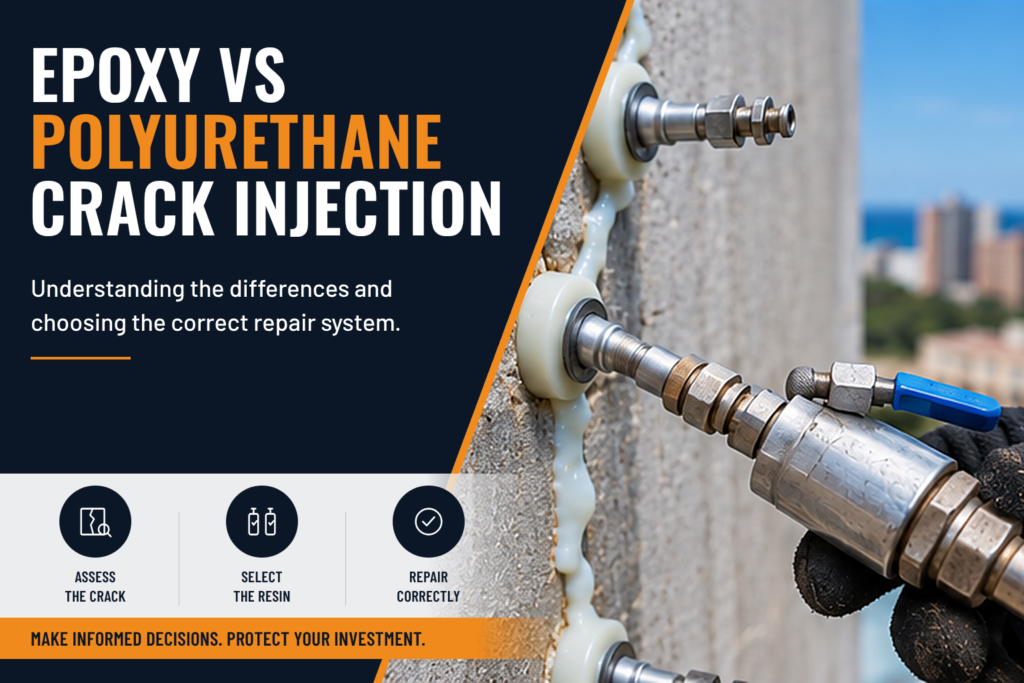
- Port installation. Injection ports (sometimes called nipples) are installed along the length of the crack at set intervals — spaced more closely for finer cracks — to allow resin to be injected at multiple points along its length.
- Surface sealing. A cap seal is applied along the entire crack face between the ports, and allowed to cure, so injected resin doesn’t simply escape through the surface instead of penetrating the crack.
- Injection. Resin is pumped in, starting at the widest section of a horizontal crack and from the bottom up on a vertical one, continuing until resin appears at the next port or the crack will take no more — ensuring the full depth and length of the crack is filled, not just the surface.
- Follow-up and finishing. Some methodologies include a second, lighter injection pass after an initial cure period to reach finer branching cracks. Once the resin has cured, the ports and cap seal are removed.
Using the right product for the right application is critical to a successful outcome. Matching the repair system to the actual cause and condition of the crack, rather than applying a standard fix, is what separates a repair that lasts from one that fails again in a few years.
What drives the cost of crack injection
Crack injection is usually priced from a site inspection, not from a standard rate, because two cracks that look alike on a photograph can need very different work. These are the factors that move the price:
- Length, width and depth of the cracks. More linear metres, and cracks that run through the full thickness of an element, mean more ports, more resin and more time.
- Access to both sides. Cracks that can be injected from one side or both affect the method and the resin viscosity.
- Resin system. Epoxy, polyurethane, or a two-stage approach (foaming resin to stop the water, then a non-foaming resin for the permanent seal) differ in material cost and in site time.
- Wet or leaking conditions. Water flow adds steps before the permanent repair.
- Access to the work. Scaffolding or rope access on façades and high-level structures can be a significant part of the total.
- Fixing the cause. If the crack is a symptom of failed waterproofing, a movement joint problem or corroding steel, that work is a separate cost, and skipping it is false economy.
- Investigation and monitoring. An engineer’s assessment adds to the upfront cost but is what makes the specification sound.
When comparing quotes, check that each one states the diagnosis it is based on and why that resin was chosen for that crack. A quote that names a product without explaining why leaves you unable to compare like with like. For the wider approval process, see what body corporates need to know before approving concrete repairs.
Why cracks in KZN buildings need diagnosing first
Not every crack in concrete is the same, and not every crack should be repaired using the same method.
Reinforced concrete structures across KwaZulu-Natal commonly develop cracks due to a combination of coastal exposure, building movement, moisture ingress, thermal expansion, and normal ageing. While some cracks are stable and suitable for structural repair, others continue to move as the building expands, contracts, or settles over time.
One of the most common mistakes is assuming that every crack should simply be filled with epoxy. In reality, selecting the wrong repair system can result in the crack reappearing or new cracks developing alongside the repair.
In coastal areas, moisture ingress often accompanies cracking. Water entering through balconies, retaining walls, roofs, and concrete slabs can accelerate reinforcement corrosion, so it’s important to identify not only the crack itself but also the underlying cause before selecting a repair method — the same is true whether you’re in Durban itself or further along the KZN coast.
For this reason, professional crack repairs begin with diagnosis, not product selection. The key question isn’t whether epoxy or polyurethane is “better”; it’s which system is appropriate for the type of crack, the movement expected within the structure, and the long-term performance required.
Frequently asked questions
It comes down to diagnosis: whether the crack is static or still moving, whether it is structural or non-structural, and whether it is wet or dry. Epoxy suits static, structural cracks that are dry or only slightly damp; polyurethane suits wet or actively leaking cracks that need a flexible seal.
Standard epoxy generally cannot, because moisture interferes with its bond and cure. Moisture-tolerant epoxies exist for damp cracks that cannot be dried out, but an actively leaking crack is usually a polyurethane job, which reacts with water rather than being defeated by it.
No. Polyurethane forms a flexible, watertight seal, but it doesn’t restore load-bearing capacity the way rigid epoxy does. If the crack is structural, epoxy, or an engineer-specified structural repair, is the appropriate approach.
It starts with an inspection to diagnose the crack: static or dynamic, structural or non-structural, wet or dry. The scope then sets out the injection method, port spacing and sequence based on that diagnosis. On site the work follows surface preparation, port installation, surface sealing, injection and removal of the ports and seal.
It depends on the length, width and depth of the cracks, whether they can be injected from one side or both, access (scaffolding or rope access), the resin system specified, and whether the cause of the crack must be fixed as well. A responsible figure needs a site inspection.
That depends on whether the underlying cause was addressed and the correct product was matched to the crack’s condition. A repair that treats a still-moving crack as if it were static, or injects a wet crack with standard epoxy, is the most common reason a repair fails again. Guarantees are tied to the materials and systems used, typically backed by both the material supplier and the contractor, and explained clearly before work starts.
Get the diagnosis right before you get a quote
If you’re dealing with cracking on a KZN building and want a proper diagnosis before deciding between epoxy and polyurethane injection — or before accepting a quote that’s already assumed the answer — Spalling Worx KZN offers site inspections and assessments, including structural crack repair and crack injection, across KwaZulu-Natal, from Durban through to Richards Bay, Port Shepstone, and Pietermaritzburg. Commercial and sectional-title buildings can book a free Asset Protection Review: a non-invasive on-site review that gives trustees and owners a photographed, phased priority plan they can budget against. Or call 082 091 7731.