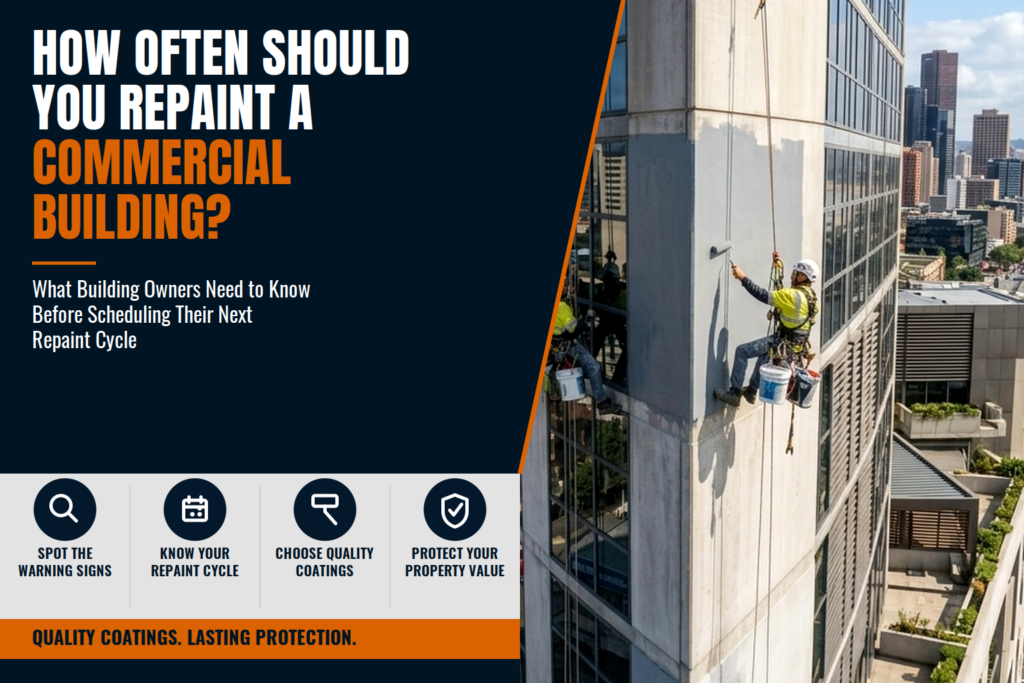
For a body corporate trustee trying to work out how often to repaint a commercial building in Durban, getting a quote to repaint the façade can raise a difficult question: is this early, on schedule, or three years overdue? Without a framework, the decision comes down to whichever contractor sounds most convincing — or gets deferred another year because nobody can say whether it’s actually necessary yet.
There’s no single correct interval for repainting a commercial building — anyone who gives you one number without asking about your building’s exposure is guessing. But there is a reliable way to think about it, and Durban’s coastal climate changes the answer more than most generic advice accounts for.
This article covers what actually determines when a commercial building needs repainting, why that interval is shorter here than inland, and how to budget for it as planned maintenance rather than a surprise expense.
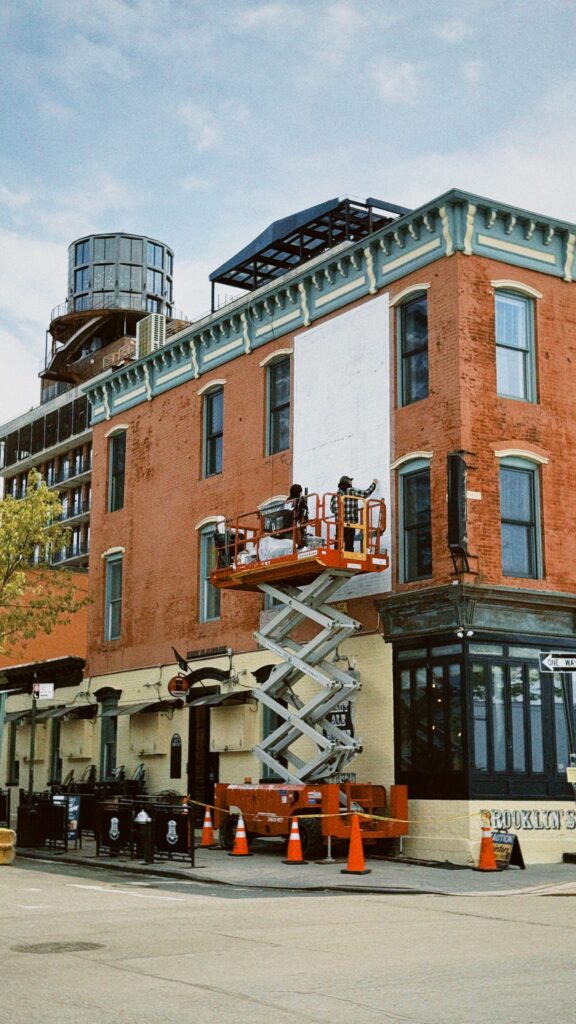
How often to repaint a commercial building in Durban depends on exposure
As a general starting point, well-applied exterior paint on a commercial building typically lasts somewhere in the region of 5 to 8 years before needing a full repaint, with interior surfaces lasting considerably longer — often 7 to 15 years, depending on wear. But that range assumes average conditions, and a coastal building in Durban isn’t average.
The more useful approach — used by mature commercial painting programmes elsewhere — is a condition-based maintenance approach: regular inspection of the building’s paint condition, rather than a fixed calendar date, drives the repaint decision. Different elevations of the same building can wear at completely different rates: a north or west-facing wall with direct sun exposure will chalk, fade, and fail well before a sheltered, south-facing wall on the same building painted on the same day. Treating a whole building as due for repaint based on its most-exposed elevation wastes money on the sheltered sides; treating it as fine based on its most-sheltered elevation risks the exposed sides failing badly before anyone notices.
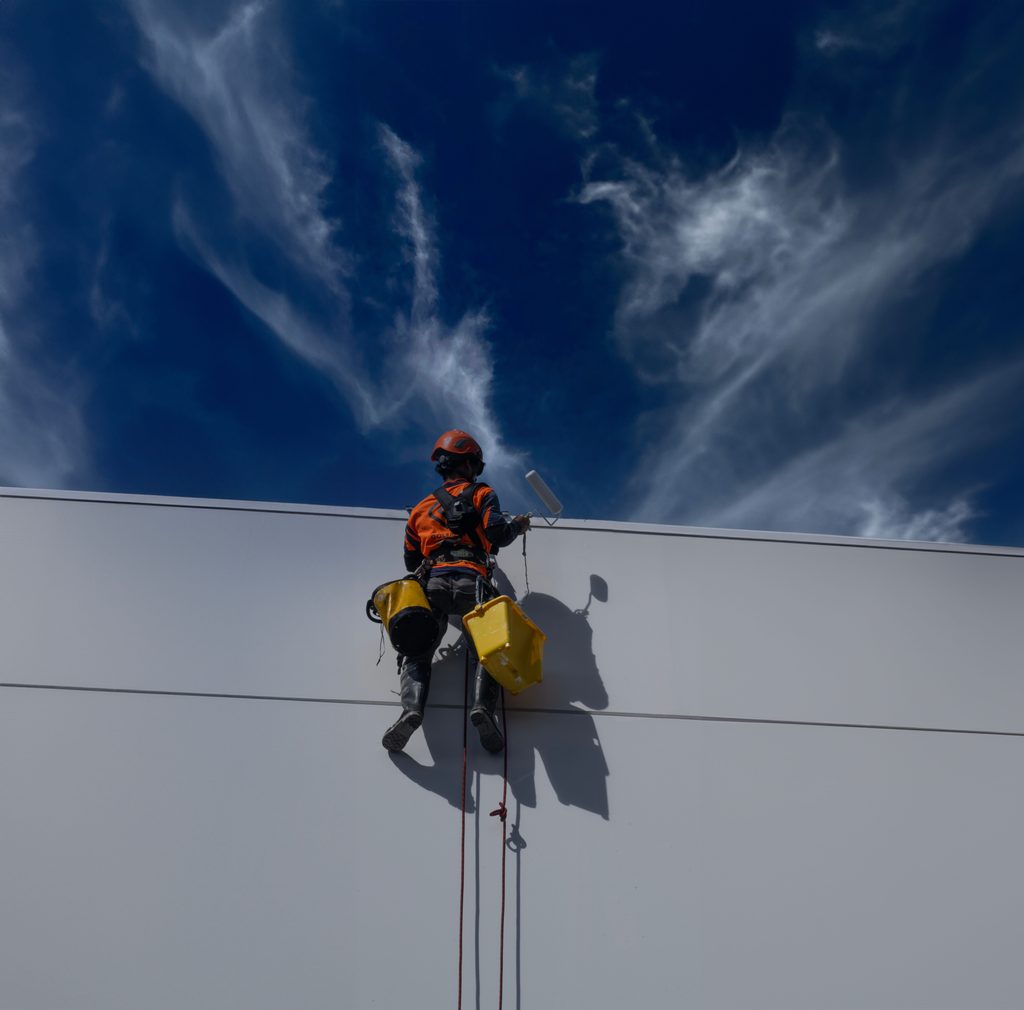
Assessing a tall commercial building elevation by elevation often means getting eyes on every surface properly, including height access via rope or scaffold — not just what’s visible from the ground.
Why Durban’s coastal climate shortens the interval
Salt-laden coastal air, high humidity, and intense UV exposure all accelerate paint film breakdown compared to a drier, inland climate — the same combination of factors that drives faster concrete deterioration across KZN’s coastal building stock also works against exterior paint. In practical terms, that means:
- Chalking (a powdery residue that rubs off on your hand) happens earlier and more visibly on coastal buildings
- Salt deposits accelerate dirt pickup and can affect adhesion over time, particularly on elevations facing the prevailing sea breeze
- UV exposure breaks down the paint film’s flexibility faster, leading to earlier cracking
For buildings in genuinely exposed coastal or industrial locations, more frequent washing between repaints — sometimes recommended as often as every six months for coastal and industrial areas — helps remove salt and grime buildup and extends the life of the existing coat, which is a cheaper interim step than an early full repaint.
The sign most people miss: paint failure can be a concrete symptom, not just aged paint
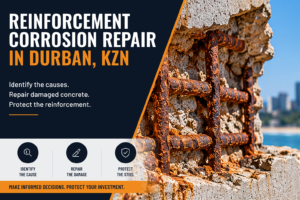
Bubbling, blistering, or peeling paint on a concrete surface isn’t always simply old paint — it can be an early visible sign of reinforcement corrosion or concrete deterioration happening underneath. Moisture and corrosion by-products pushing against the paint film from below produce exactly the kind of localised bubbling or flaking that’s easy to mistake for a straightforward repaint job.
This matters for how a repaint gets scoped: a contractor who sands, primes, and repaints over that kind of localised failure without investigating what’s causing it is treating the symptom, and the same bubbling will reappear in the same spot within a year or two, because the actual cause was never addressed. A proper assessment before repainting should distinguish between “this paint has simply aged” and “something underneath this paint needs attention first.
Budgeting for repainting as planned maintenance
Repainting is far more manageable, financially, when it’s planned into a body corporate’s maintenance budget or reserve fund ahead of time rather than approved reactively once the building already looks visibly tired. A condition-based inspection every few years — checking each elevation rather than assuming uniform wear — gives trustees advance warning of what’s coming and roughly when, which makes it possible to budget for it rather than be surprised by it.
We will never compromise on quality — in a market where a lot of contractors compete on price, a premium exterior coating system properly applied costs more upfront than a budget option, but it extends the interval between full repaints, which usually works out cheaper over the building’s life than repeated cheaper jobs that fail early. Using the right product for the right application applies here too: a coastal-rated exterior system suited to salt exposure and UV is a different specification to what’s appropriate on a sheltered inland building, even if both look the same in a catalogue.
Choosing a paint system for Durban’s conditions
There isn’t one fixed brand or system we default to. On many commercial jobs, the paint manufacturer is specified by the project’s quantity surveyor as part of the tender documentation, and the job gets specified accordingly. Where the specification is open, we choose the system based on what makes commercial sense for that building’s exposure and budget, drawing on our supplier relationships rather than a single default.
What doesn’t change, regardless of manufacturer, is the standard the system needs to meet for coastal exposure: genuine exterior-grade protection against UV and weathering, with fungicide/algaecide protection against surface growth in KZN’s humidity — the kind of specification coastal-rated ranges like Dulux’s Weathershield are built around, as one example of what “coastal-rated” actually means in practice. As with any coastal application, proper surface preparation matters as much as the product itself: a premium coating applied over poorly prepared substrate will fail early regardless of which manufacturer supplied it.
Why repainting is often reactive on KZN’s coast
Painting decisions on KZN’s coastal buildings are often made reactively — once the building visibly looks tired — rather than as part of a planned maintenance cycle, and that reactive pattern is exactly what leads to a bubbling or flaking paint symptom being repainted over rather than properly investigated first. It’s the same pattern seen with concrete deterioration generally across the region’s coastal building stock: early signs (cracking, flaking paint, bubbling paint) get dismissed as cosmetic until the underlying problem has grown considerably larger and more expensive to fix — the same is true whether you’re in Durban itself or further along the KZN coast.
Frequently asked questions
How much does it cost to repaint a commercial building in Durban?
It depends on the building’s size, the paint system specified, and how much surface preparation is needed — a coastal building with existing paint failure or underlying concrete issues costs more to prepare properly than a well-maintained building on a routine cycle. A proper site assessment comes before a firm price.
How do I know if my building’s paint failure is just age, or something more serious?
Widespread, even fading and chalking across a similarly-exposed elevation is usually just paint reaching the end of its life. Localised bubbling, blistering, or flaking in specific spots — especially on concrete elements — is worth having assessed before simply repainting over it.
Can you paint an occupied commercial building without disrupting tenants?
Yes — this needs to be planned into the scope, including phasing, access, and timing, alongside the paint specification itself, rather than being worked out on site once the job has already started.
How would you carry out the scope of works?
It starts with a condition assessment of each elevation, distinguishing straightforward aged paint from any areas that need investigation first, before specifying the paint system and sequencing the work.
Do you guarantee your work?
Guarantees are tied to the materials and systems used, in addition to the labour, typically backed by both the paint supplier and the contractor, and explained clearly before work starts rather than after.
When to repaint a commercial building in Durban
If your body corporate or facility is trying to work out whether a repaint is due, overdue, or premature, Spalling Worx KZN offers site inspections and assessments across KwaZulu-Natal, from Durban through to Richards Bay, Port Shepstone, and Pietermaritzburg. Call 082 091 7731 to arrange a site assessment, or see our commercial painting services in Durban and KZN. Body corporates can also book a free Asset Protection Review.