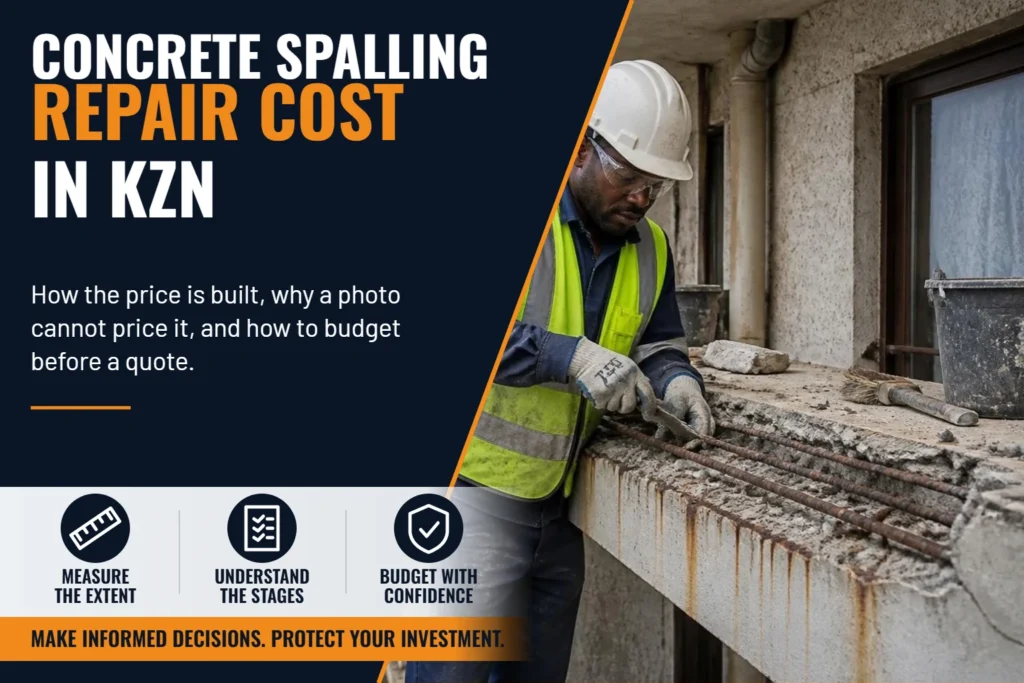
Someone sends a photo of a crack with a rust stain running out of it and asks, “What will that cost to fix?” It is a fair question, and it is the one question nobody can answer honestly from a photograph. The picture shows the end of a process that has been running inside the concrete for years. The price depends on how far that process has got, and you cannot see that from the surface.
This article does not give you a rate per square metre, because any rate quoted without a site inspection is a guess. It explains instead how a concrete spalling repair price is built, why the visible damage is usually the smallest part of the job, and how to put a sensible budget together before you have a quote. If you are the trustee or managing agent who has to approve a quote, our guide for body corporates on reading and approving concrete repair quotes picks up where this one stops.
Why you cannot price spalling from a photo
Spalling happens because reinforcing steel inside the concrete corrodes. Rust takes up more space than the steel it came from, so it pushes the concrete cover off from the inside. By the time you can see a crack, a bulge or a patch of fallen concrete, the corrosion has usually been working for some time, and it does not stop at the edge of what you can see.
That has three consequences for cost:
- The affected area is bigger than the visible area. Corrosion travels along the reinforcement, and concrete around the visible damage can already be separated from the steel without showing a crack. Tapping the surface and listening for a hollow sound is how this is mapped on site.
- The depth is unknown. How far the corrosion has progressed, and whether the steel has lost enough section to need strengthening, only shows once the unsound concrete is removed.
- The cause is unknown. A roof or balcony that lets water through, chloride from coastal air, or carbonation each call for different treatment. The wrong assumption about cause is how a repair ends up being paid for twice. See what causes concrete spalling for the warning signs.
The unsound area marked out on site is often larger than the damage that prompted the call. That is why serious contractors inspect before they price, and why a quote given over the phone for a spalling repair should be treated as a rough indication at best.
How the cost is built, stage by stage
Every spalling repair follows the same sequence of work. Each stage carries its own cost, and each stage is affected by what the stage before it finds. Our own five-step process is inspection, removal, treatment, application and protection. Here is where the money goes in each.
1. Investigation and assessment
A proper assessment records the extent of the damage, its likely cause and the condition of the concrete around it. On larger or more serious cases, testing and an engineer’s input may be appropriate, and where structural assessment, design or certification is needed, that is done by an appropriately qualified engineer appointed by the client or agreed separately as part of the project scope. This stage is a small fraction of the total, but it sets every quantity in every stage that follows.
2. Breaking out the damaged concrete
All loose and unsound concrete has to come out, back to sound material, and usually past the corroded steel so that the steel can be cleaned all the way round. The cost here depends on how much concrete is affected, how deep, and the method used to remove it. Removal also generates debris that has to be contained and taken away.
3. Treating and, where needed, replacing the reinforcement
The exposed steel is cleaned of rust and treated. Where corrosion has reduced the steel significantly, it may need supplementing or replacing, which is a structural question and one for the engineer. This is the stage where cost can change most once the work is open, because the condition of the steel is not known until it is exposed.
4. Rebuilding the concrete section
The repair material and its method depend on the size and position of the repair: patch repairs with polymer-modified mortars, structural repair mortars, sprayed concrete or form-and-pour for larger sections. The right choice is driven by the substrate, thickness, loading and location, not by price. Our guide to concrete spalling repair methods covers the options.
5. Protecting the repair
Anti-carbonation or chloride-resistant protection is what keeps the repair, and the concrete around it, from going the same way. It adds to the first cost and is the stage most often cut when a budget is squeezed. The cost of leaving it out tends to arrive later, in the same place.
6. Access, safety and site costs
Often the single largest swing. The same repair at ground level and on the eighth floor of a coastal block are different jobs. Scaffold, suspended platforms or rope access, hoisting materials and removing debris, safety planning for work at height, and the size of the working area all affect cost. On occupied buildings, working hours, noise and keeping walkways clear shape the programme, and a longer programme costs more.
7. Supervision and guarantee
Quality control and guarantees vary from project to project. Where a repair system carries a supplier guarantee, its conditions can include the use of approved materials and applicators, inspection or sign-off at agreed stages, and documented handover, depending on the supplier, the system and the project. We match the guarantees our material suppliers offer for the system used. The supervision, testing and documentation a project calls for are part of delivering a repair that can be guaranteed, and are part of the price.
How a contractor turns those stages into a price
Most serious quotations are built from some or all of the following, however long the document looks:
- Quantity x rate. Each item of work (break-out, reinforcement treatment, repair mortar, protective coating) is measured in square metres, metres or litres, and multiplied by a rate for that item.
- The rate is built from two things. The material one unit consumes (how much product a square metre or a metre of edge takes) and the labour one unit consumes (what a crew can realistically achieve in a day for that kind of work). Slow, careful work such as breaking out and patching costs far more per square metre than rolling on a coating, even though the workers earn the same. Work from a suspended platform or rope access is slower again than work from the ground.
- Preliminaries. The cost of simply being on site: supervision, access equipment, safety planning, protection of the public and occupants, and waste removal. On a small job, preliminaries can be a large share of the total.
- Provisional amounts, where appropriate. Money set aside for work nobody can measure yet. For spalling, that is usually the concrete that will only be found to be unsound once breaking out starts. Not every quotation carries one; it depends on the scope and on whether the extent can be measured in advance.
- Contingency and variations, where appropriate. Where a contingency is included, it covers genuine surprises and is spent only as directed. Not every quotation has one. Extra work instructed beyond the agreed scope is priced separately at agreed rates.
Where a quantity surveyor issues a bill of quantities, the contractor prices rates against quantities that someone else has measured, and the provisional items stay under the client’s control. Where nobody has measured, the contractor measures and decides the scope, and the assumptions and exclusions matter even more. That is why two quotes with similar totals can rest on very different assumptions, and why the assumptions are worth reading.
Why the quote can change once the work starts
When the concrete is broken out, the real extent shows. A good quote deals with this openly rather than hiding it: it sets out what has been measured, what has been assumed, and how any difference will be handled.
Documents we have worked with show how routine this is:
- In a visual assessment we carried out in September 2026 of an occupied residential block of roughly 50 years, the report recorded spalling at roof-slab edges, balcony corners and fin junctions. It also stated that the true extent of delamination was likely to be greater than what was visible, and should be confirmed by hammer sounding and a closer inspection. This was an assessment, not a completed repair, but it states the principle in plain terms.
- A body corporate’s own specification for spalling repairs to walkway edge beams, issued to us to price in September 2026, said that the exact extent of defective concrete may only become apparent once breaking out begins, and that repair material and additional reinforcement quantities were therefore provisional, to be adjusted to the work actually executed. It also required breaking out to extend beyond all visibly defective material, and work to stop for the appointed professional’s instruction where substantial loss of reinforcement was found.
The point for anyone budgeting is that the first number is an estimate of an unknown quantity, and the people who write specifications for a living build that uncertainty into them. Our view is simple: we compete on the quality of the repair, not on price alone, because matching the repair system to the actual cause is what separates a lasting repair from one that fails again in a few years, and the second repair costs more than doing the first one properly.
Why deferring a repair raises the cost
Reinforcement corrosion does not pause. Across KZN’s coastal building stock, minor defects such as small cracks, rust stains and bubbling paint are often dismissed as cosmetic, but are frequently early signs of corrosion developing beneath the surface. By the time concrete is visibly falling away, the repair is usually far more extensive than it would have been if it had been caught early. A larger repair means more removal, more steel treatment, a longer programme, more access time and more disruption to the people in the building.
Cost also depends on getting the cause right the first time. A patch repair that leaves chloride-contaminated concrete around the steel can fail where the original damage did not. University of Cape Town research on repairing corrosion-damaged reinforced concrete reports that new corrosion sites (“incipient anodes”) often form beside a patch and can lead to accelerated patch failures in as little as two years, and it advises removing chloride-contaminated concrete from the vicinity of the reinforcement.
It also sets out other repair strategies, such as protective measures applied to the repaired concrete, with different costs and expected service lives. Which strategy suits a given structure is a design decision made after investigation, not something to assume from a photograph. The source is Mackechnie and Alexander (2001), Repair principles for corrosion-damaged reinforced concrete structures, Research Monograph No. 5, University of Cape Town.
The practical detail is in our article on reinforcement corrosion repair in Durban. Where water is getting in through a failed roof, balcony or retaining wall, fixing the waterproofing is part of the repair budget, not an extra: see concrete waterproofing for KZN buildings.
How to build a budget before you have a quote
You can plan sensibly without a price. Here is how.
- Get a survey first. Budgeting from photos is how budgets end up wrong in both directions. A site assessment gives you quantities, a cause and a recommended method.
- Ask for the quantities, not just the total. Measured areas, depths and metres of edge by element (soffits, columns, balcony slabs, parapets) are what let you compare quotes and re-measure honestly later.
- Separate the repair from the protection and the access. Three lines tell you more than one total.
- Decide how you will treat unknowns. Provisional items or allowances for what only shows once work is open is a decision for you, your managing agent and, where needed, your engineer. We will not put a percentage on it here.
- Check the cause is in the scope. If water or chloride is still reaching the concrete after the repair, the budget is incomplete.
- Plan for staging on large buildings. Spreading work across elevations or financial years can make budgets manageable, provided the most urgent areas are done first and the scope is written down.
Frequently asked questions
There is no honest single figure. The price depends on the measured extent of damage, the depth and the condition of the reinforcement, the access method, the repair system specified, the protection applied and the conditions on site. A site inspection turns those unknowns into quantities, and a written, itemised quotation turns quantities into a price.
Yes, in most cases, where the concrete and steel are repaired properly and the cause is dealt with. Where large sections are detached or the steel has lost significant section, a structural engineer should be involved before repair is specified.
Spalling is a sign of reinforcement corrosion, and falling concrete is a safety risk to people below. How serious it is for the structure depends on how much steel has been affected and where. That is a question for an assessment, and for an engineer where structural capacity is in doubt.
It depends on whether the cause was addressed, on how well the steel and concrete were prepared, on the system used and on the exposure. A repair that treats the cause and is protected suits the conditions far better than one that only replaces what fell off. Exact service life is not something we promise in an article; it is set out in the guarantee terms in your written quotation.
Only a rough indication, and it will not hold. A photo shows the surface and cannot show how far the corrosion extends, how much concrete is unsound or what condition the steel is in.
Next step: a site assessment
If you are budgeting for concrete repairs, start with a proper look at the concrete. Spalling Worx KZN carries out site assessments across Durban and KwaZulu-Natal. We identify the cause, mark out the extent, and give you a written, itemised scope and quotation, so your budget is based on measured quantities rather than a guess.
Request a Site Assessment or call 082 091 7731. You can also read about our concrete spalling repair in Durban.