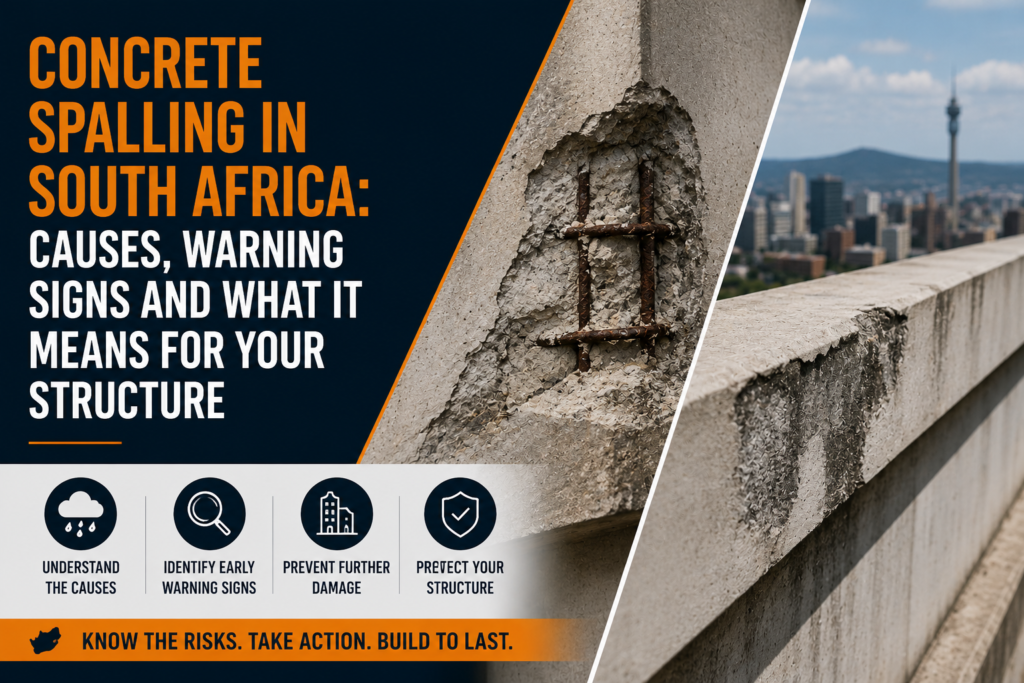
Concrete spalling is a widespread issue across South Africa, affecting residential buildings, commercial properties, parking structures, and public infrastructure. While it often begins as a minor surface defect, it is typically a visible sign of deeper structural deterioration—most commonly linked to reinforcement corrosion.
Understanding the causes of concrete spalling is essential for property owners, body corporates, and asset managers looking to protect long-term structural integrity.
What Is Concrete Spalling?
Concrete spalling occurs when the surface layer of concrete cracks, flakes, or breaks away, often exposing the reinforcing steel (rebar) beneath. This process is rarely isolated—it usually indicates underlying chemical or environmental damage.
Primary Causes of Spalling in South African Conditions
Carbonation (Most Common in Urban Areas)
Carbonation is one of the leading causes of spalling in inland cities such as Johannesburg and Pretoria. Carbon dioxide from the atmosphere penetrates the concrete and reduces its alkalinity, removing the natural protective layer around embedded steel.
Once this protection is lost, steel begins to corrode, expand, and crack the surrounding concrete.
Chloride Attack (Coastal Regions)
In coastal areas such as Cape Town, Durban, and Gqeberha, chloride exposure from sea air significantly accelerates corrosion. Chlorides penetrate the concrete and directly attack reinforcement, even if alkalinity is still present.
Chloride attack is the main concern on the KZN coast, where it is often combined with carbonation. See concrete spalling repair in Durban and our guide to reinforcement corrosion repair in Durban and KZN for how it is diagnosed and treated.
Poor Construction Practices
Spalling is often linked to:
- Inadequate concrete cover over reinforcement
- Poor compaction leading to voids
- High water-to-cement ratios
- Inconsistent curing practices
These issues reduce durability and increase permeability, allowing aggressive agents to enter.
Water Ingress and Drainage Failures
Leaking roofs, balconies, and inadequate drainage systems allow moisture to penetrate concrete, accelerating deterioration. Where a leak is the cause, the waterproofing has to be addressed as well as the concrete: see concrete waterproofing for KZN buildings.
Warning Signs to Watch For
Early detection is critical. Common indicators include:
- Rust stains on concrete surfaces
- Cracking parallel to reinforcement lines
- Hollow-sounding areas when tapped
- Flaking or delaminating surfaces
Why Spalling Should Be Taken Seriously
Concrete spalling is not just cosmetic—it can:
- Compromise structural integrity
- Reduce load-bearing capacity
- Create safety hazards from falling debris
- Lead to costly long-term repairs if ignored
To tell cosmetic spalling from structural damage, read when concrete spalling becomes a structural risk; for how it is properly repaired, see concrete spalling repair methods; and to stop it starting, preventing concrete spalling.
Conclusion
In South Africa’s varied climate, concrete spalling is often inevitable without proper design, construction, and maintenance. Early identification and intervention are key to preventing serious structural issues and preserving asset value.
Spalling Worx KZN offers site inspections across KwaZulu-Natal. Commercial and sectional-title buildings can book a free Asset Protection Review, or call 082 091 7731.
References
- SANS 10100-1 & 2: Structural Use of Concrete
- Cement & Concrete SA: Concrete Surface Defects and Repairs Guide
- The Concrete Institute (South Africa): Durability of Concrete Structures
- CSIR Built Environment Research Reports